Friday, May 1, 2015

You Don't Have to Eat Cuy, Roy


The taxi driver and I have been speaking – yes, all in Spanish, thanks - for the past forty five minutes as we drive into Quito. Alright, he’s been speaking. I’ve been throwing out responses like “Si,” and “No,” and “Claro!” and “Verdad?,” because to do more would be pushing the boundaries of my linguistic skills. We’ve talked about the new airport (yes, it’s really far from town), baseball (apparently they do play baseball in Ecuador), traffic (yes, lots of traffic), and have now moved on to food.

Every taxi driver in South America, I continue to discover, is an expert on food.

“Have you had the cuy?” my driver asks me.
I’ve only been in the country for a little over an hour, so unless he’s referring to something you pick up at the airport baggage claim men’s room, I suspect the answer here would be no. We are still talking about food, right?

“What’s cuy?” I ask him. “Is that some kind of fish?”
I don’t think that’s such a bad guess. You know, like a cuy pond. Oh, that’s a koi pond? So never tmind.

He laughs. “You don’t know about cuy?”

Yes, I feel stupid, but again: in the country all of one hour. We probably should go back to baseball. “A vegetable?”

This guy thinks I’m hilarious. He declines to explain further, but gives me the name of a restaurant near my hotel in the Mariscal section of Quito, where – the driver says – I’ll be fine if I avoid the drug dealers. Make sure you go to this restaurant, he tells me, and ask for the cuy.

“But not the vegetable cuy,” he says. And he laughs and laughs and laughs.

*          *          *         

There are women in my life of a certain predilection - and they know who they are -  who worship Anthony Bourdain. Many possible reasons (the New York swagger, the 6 ft., 4 in. frame, the distinguished grey) I’m sure, but I suspect it really boils down to one thing: Anthony Bourdain has the cajones to walk into any food shack in any unpronounceable, back-water village in the world and eat absolutely anything.

Brains, entrails, organ meat, horse heads cooked in dirt, fried testicles, sautéed esophagus … if you can dream it up, cook it (or not), and throw it on a plate (or not) he will eat it. He is the Super Hero of the Foodie Generation: the good-looking rebel who plays by his own rules, travels the world, hosts his own TV show, eats donkey eyeballs, and his spare time whips up a mean cheese soufflé. 

Of course I suspect Anthony Bourdain also spends a lot of time throwing up off camera. But give the man his due: he has constructed a larger-than-life persona around the courage to gamely sample the world’s most repulsive cuisines. The girls just eat it up. So to speak.  

I can’t hope to compete with Mr. Bourdain in the Bizarre Food/Iron Stomach Competition, but I do try to eat like the locals whenever possible. In fact my final meal in Medellin, Colombia before arriving in Ecuador was mondongo, a thick, stew-like dish of which the main ingredient (or at least the only one I’m cursed to remember) is diced tripe. 

 Try ordering that at your neighborhood Applebee’s.

So whatever cuy is, I’m sure I’ll eventually get around to trying it at some point during my stay in Ecuador. I mean, come on. You’re talking to a man who ate haggis in Scotland, and only hours before polished off a steaming bowl of chopped pig intestine soup. If in Ecuador what they eat is cuy, I will eat cuy.

It’s what Anthony would do.

*          *          *

When I get to my hotel room and connect to the Internet, I Google cuy.
Oh. I see.

So this is why no one in America has dared to open an Ecuadoran restaurant at the mall food court.

At least not near the pet store.

*          *          *

Cuy, or Guinea Pig, as it’s known where I come from, shows up on the menu for the first time the next evening, at La Petit Mariscal, a Belgian/Ecuadoran restaurant (no, that is not a typo: a Belgian– slash – Ecuadoran restaurant) recommended by my hotel desk clerk. The clerk’s attitude while sending me on a ten-minute walk through the Zona Rosa after dark could best be described as “casually concerned.” Like the taxi driver, he cautions me about drug dealers on the street corners.

“Eight, nine o’clock, you should be okay,” he tells me. “No problem.”
“What about ten o’clock?”
He pauses and looks briefly at the ceiling. “Probably okay.”
“Probably?”
“Just watch out for the …”
“… drug dealers on the corner. Like you said. After ten. Got it.”

The drug dealers in Mariscal are pretty easy to spot, positioned about every other block or so like personal greeters at the door of the neighborhood Wal-Mart. Except that they are considerably younger than the greeters at Walmart. And they don’t smile, or greet you. And you know, they’re selling drugs.

Yet walking down unfamiliar South American streets in the non-family friendly side of the city, I don’t feel particularly uncomfortable. There are plenty of people on the sidewalk as an early crowd lingers outside of bass-thumping discos and sad little karaoke bars, and the cops in the center of Foch Square more or less outnumber the drug dealers. Besides, I decide that I really don’t have anything to fear from the boys on the corner. These are not the guys who are going to mug me; they have business to do, and if I’m not buying, they’d just assume I have a nice night and be on my way. God bless Entrepreneurial Capitalism!

As far as I’m concerned, the Special of the Day printed on the restaurant menu is a lot more frightening than anything out on the sidewalk.

GUINEA PIG ROLL/ENROLLADA DE CUY
We serve it without the bones; stuffed with vegetables and a sauce made from the cuy itself


There it is: Guinea Pig Roll. Like a South American version of the Taco Bell Burrito Supreme. Guinea Pigs in a Blanket. With Guinea Pig Sauce!

I send a text to P. to inform her of what’s on the menu in Ecuador, expecting some solidarity in my hesitancy to eat the family pet for dinner.

“Order it!” she responds emphatically. “I would!”

I look at the text and then back at the menu.
“Really?” I text. “Doesn’t this come dangerously close to eating a rat?”

“Don’t be afraid,” is the text that comes back, but I can feel the subtext hanging in the air a continent away: “Don’t be afraid. You wuss.” I know when my manhood is being challenged.

Damn you, Anthony Bourdain.

Guinea Pig. Guinea Pig Roll. I’m wondering if this is served with a side of wood chips.
The waiter is now hovering over me, order pad in hand.

“Do you know what you would like, señor?”

I let out a heavy exhale as I hand him back the menu. I notice my palms are sweaty.
“I’ll have the chicken.”

“Very good, señor. The chicken.”
The chicken, his expression tells me. For the chicken.

*          *          *

The next day I get a Facebook text message from the Ex, currently located in Abu Dhabi. She tells me she’s headed out to the desert soon, to ride camels. My God, life is strange.

“How’s the South America trip going?”

“Fine,” I text back. “Hey let me ask you a question. Do you know what cuy is?”
“No. Do you?”
“I do after Googling it. It’s Guinea Pig.”
“Ah.”
“The question is, would you eat it?”

She tells me a man at a cookout in Queens once offered her a Guinea Pig on a stick.
“It wasn’t done yet,” she writes, “or I would have tried some.”

Come on. Really?
“But isn’t this like eating cat? Or rat?”

“Oh, I would try it. It’s not like eating a rat. More like a bunny.”


Apparently I am surrounded by indiscriminate, flesh-eating carnivore women. What does this say about me?

“I’ll eat anything,” she continues. “Except maybe brains. But then someone told me they were really good, so …”

“Really?” I’m incredulous. “Cat? Dog?”

“You know, if it’s on the menu … I might try it.  I ate horse. I ate a rabbit. These are all friendly creatures. Does that make me a terrible person?”

I’m about to respond that, yes, that does kind of make you a terrible person, but then I stop and think. I also have eaten horse and rabbit, which, I have to admit, probably qualify as pets as much as a Guinea Pig does. In fact, I now remember the Ex herself once had a pet rabbit. I even remember the damn thing’s name.

And yes, I’m sure there’s some kid out on a farm somewhere that has a pet chicken.


“Okay,” I type. “That actually kind of helps, thanks. Enjoy your camel ride.”

*          *          *

By the time I get to Cuenca I am resolved to dive in for the complete Guinea Pig Experience. None of this sissified, Belgian-influenced, de-boned, cuy burrito crap. If I’m eating cuy, I’m eating it like the Ecuadorans do: rotisserie fried until that little sucker is cooked to a crisp.

I Google “Best Place to Eat Cuy in Cuenca.” The number one hit is a block and a half from my hotel. I’m going in. And I haven’t even had a drink yet.

The logo on the sign outside of Guajibamba tells me all I need to know: a smiling cook in a monogrammed apron and Chef Boyardee hat, proudly holding a Guinea Pig impaled on a stick. Pretty sure I’ve got the right place.

Like much of South America, dinner in Ecuador before nine o’clock is like going to the Early Bird Special at Denny’s; you only go if you’re over 65 or really, really hungry.  At 8:00 p.m. the only others in Guajibamba are a scattering of tourists and a couple of Ecuadorans, obviously having a late lunch. But the last thing I’m looking to be is fashionable.

When I inform the waitress that I want to try the cuy, she tells me three things. First, the only way to “try” the cuy is to order it whole. This isn’t Boston Market, where you can get half a chicken and a side of cole slaw. The whole cuy at Guajibamba cost $21, twice as much as anything else on the menu. Fine; bring it on.

Next, she tells me, the cuy takes an hour to prepare. Not a problem, I answer. The last thing I want is undercooked cuy.

Finally, she tells me (I swear), that before I place the order, she’s going need my name, hotel, and passport number.  I don’t have my passport, I tell her. She shrugs. Just your name and where you’re staying then.

My Spanish isn’t good enough to ask why this information is required. Are they worried that I’m going to chicken out during the hour-long preparation time and walk the check? Or is it because in case of a medical emergency involving cuy, the restaurant by law needs to notify someone at the U.S. embassy?

Some things are better left unasked.

*          *          *         

The hour-long Countdown to Cuy has begun. To pass the time I have been given a bowl of salted corn nuts, and steaming teapot of canelazo. The canelazo is
a hot mixture of sugar, water, lemon, and zhumir – the rum-like, national liquor of Ecuador that comes in at 80 proof.  It takes all of about forty-five seconds for the buzz to hit me.


It’s good. Really good. I suspect it would be really, really good if you were delirious and in bed with the flu.

I sip my canelazo, munch a corn nut, and check my watch. Thirty five minutes until the rat arrives. I feel a death-row inmate, waiting for my execution at midnight.

I text P. a status report.
“Almost cuy time.”
“Aren’t you excited? Send me a pic as soon as it arrives!”

I think about the question.
“I am excited,” I text. “I also feel like a contestant on Fear Factor.”

The waitress comes by to ask me if I’d like any more corn nuts. Didn’t Mom always used to say, don’t fill up on corn nuts; you won’t have any room left for Guinea Pig?
No, I’m pretty sure she never formed that particular sentence.
Wow, the zhumir is really kicking in.

“No, gracias, pero un poco mas de canelazo, por favor.”

She nods and yells back to the kitchen, something that I suspect roughly translates as “Drunk Gringo at Table Six!”

Canelazo-fueled courage. Maybe this is how Anthony does it.

*          *          *

As promised, after an hour the cuy arrives at the table, accompanied by a side of potatoes, hard-boiled eggs, and a bowl of mote (white hominy). But am I really paying attention to potatoes? I’ve seen potatoes. No. I’m pretty much riveted by the Guinea Pig, literally standing on the plate in front of me. It is whole, roasted, and poised with tiny claws on all fours, like a sprinter in the starting blocks of a track and field event.


And there you have it: Cuy.
But not the vegetable cuy.

The waitress stands by proudly, saying she wanted to show it to me before they cut it up. “Por supuesto,” I say. Of course! How else would one serve a Guinea Pig? I snap a picture and text it to P. Her response comes in five seconds.

“No!!!!!”
“Oh, yes,” I reply. “Pictures don’t lie.”
“Oh … my … God!”

The waitress has taken my main course back to kitchen. I can hear the echo from the butcher block as they complete the non-ceremonial Chopping of the Guinea Pig.  The animal comes back to my table in fifths: right rear, left rear, right front, left front, and head.


Of course you get the head. What, you think that goes in the trash?

With a smile and a “buon provecho,” the waitress leaves me to wrestle with my fried ratty. I pick up one of the hind quarters, and take a bite. Tastes just like chicken, right? Doesn’t every strange food we’ve never had before taste “just like chicken?”

Cuy doesn’t taste just like chicken. I’m not sure it tastes just quite like anything I’ve ever eaten before. The skin is fried crunchy and salty, putting it somewhere in the pork rind family of food products. Once past the crunchy skin, I have to work to get at the meat. The bones are small. I try not to look at the tiny claws.

My phone vibrates with a text from P.  I put down my rat leg.

 “I can’t stop laughing. How is it?”
“It’s difficult to eat, to get at the meat.”
“Is it awful?”
I answer honestly. “When you get it, it’s actually pretty tasty.”
“Get in there! You know I’d be picking it up!”

Way ahead of you, sweetheart.

I work my way through the two hind quarters and tackle the front. There are some pungent internal organs (what, you think they took those out?) that are a little organ meat-y for my taste, but I eat that, too.

I’m almost through the entire body, and I am stuffed full of Guinea Pig. I may never be Anthony Bourdain, but I’m pretty proud of myself, and, a little drunk. I look at the final piece on the platter in front of me.  I put down a claw and text P.

“It’s not bad,” I report. “But I’m sorry. I’m not eating the head.”
She can’t believe it.
“That’s going to be the best part!!
At least try an ear.”

I’m not nearly drunk enough to nibble on a Guinea Pig ear. But I can’t help but smile, and type out another text.

“This would be a lot more fun if you were here, you know.”
“Of course it would.”

I can’t eat another bite. But I consider asking if they possibly serve canelazo for dessert.

“Someday,” I type out as the waitress clears my plate, “We’ll come to Ecuador together. And we’ll share a rat.”


“I can hardly wait.”

Friday, November 28, 2014

The Kids in the Upper Deck


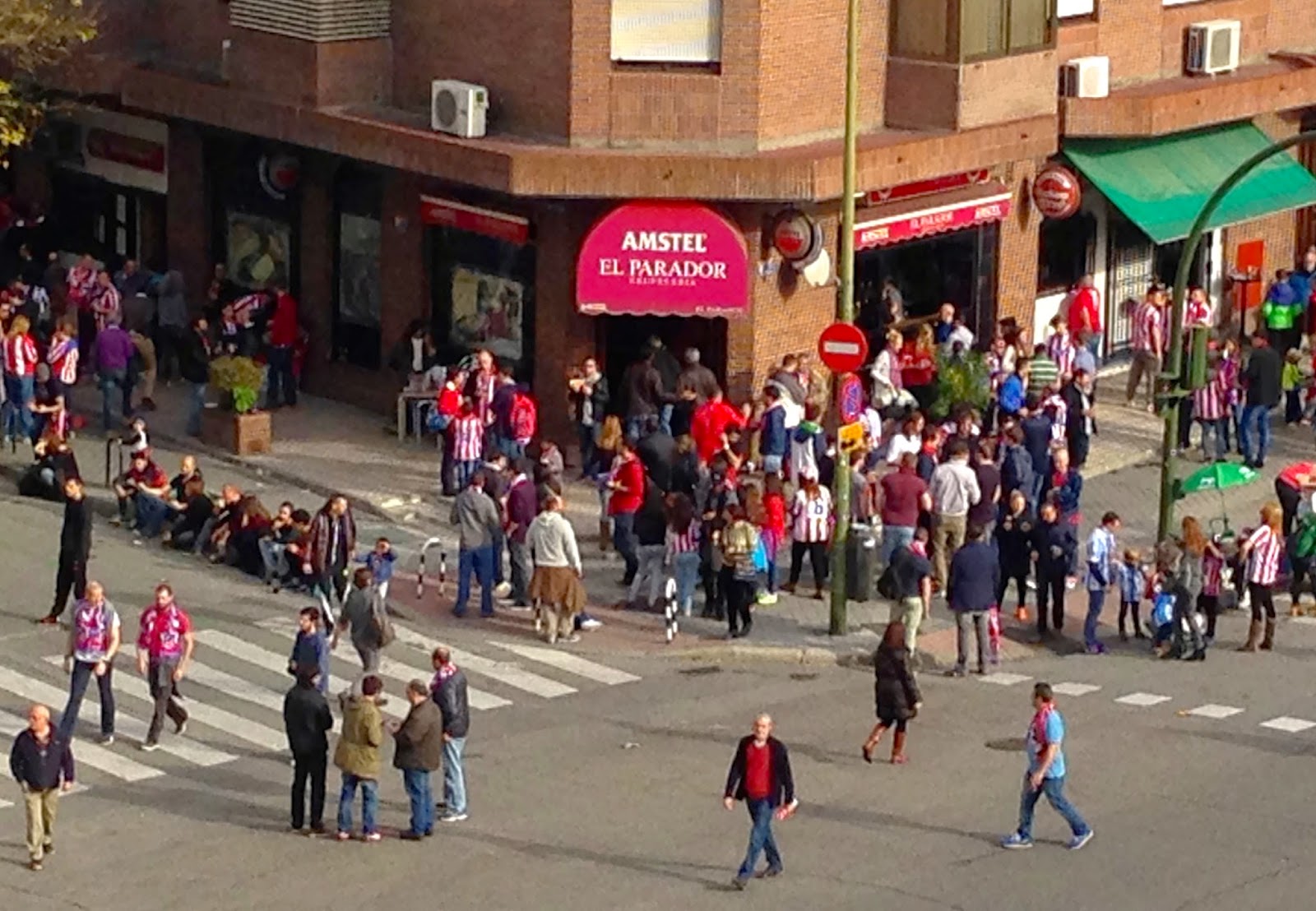
I’m perched on a bar stool at El Parador Cervecería across from Vicente Calderon Stadium two hours before game time, nursing my cerveza grande in a giant plastic cup. The brunette next to me? Sipping an orange juice.  She’s decked out in the trademark red, white and blue jersey of Atlético Madrid; I have opted for a only-slightly-less-gaudy red warm-up jacket and matching team scarf. 

In many countries my outfit would be mercilessly mocked and ridiculed, but here? Muy, muy guapo.

The girl looks at my jacket out of the corner of her eye as she opens her mouth and bites her sandwich. I smile and nod at her jersey. Clearly we’ve bonded.

 Her name is Paula. She is a big Atlético fan. She’s six years old.

These European soccer hooligans are just adorable.


“Do you know what time they open the gates?” Dad asks me in Spanish, as he and his wife take turns steadying Paula on the barstool. Apparently I look like someone who knows. “Three thirty?”

Of course I have no idea but automatically assume my default mode of faking it with conviction. “No, at three, I think,” Complete guess but let the man dream. Mom gives me a worried-looking nod, calculating how they are going to entertain a six-year-old in a bar for another 45 minutes. Paula doesn’t seem particularly concerned.

They say that in Spain, soccer (or football, as anyone outside of North America calls it) is a religion.  If that’s the case, it looks like I just walked into the early service Sunday School.

In eight days, an early morning, pre-arranged rumble on a bridge outside Vicente Calderon stadium between radical Atlético and Deportivo supporters will leave a man dead, after he falls - or is thrown - into the river during the fight. Twenty fans will be arrested.

But today I'm seeing none of this.

Where are the screaming fanatics? Where are the drunken brawls? With multiple families and kids under twelve, El Parador looks less like a testosterone-infused sports bar than it does a tram stop at Disney World.

I’ve been hanging out here with Paula and her parents for the past half hour, waiting for the start of the Spanish La Liga matchup between hometown Atlético Madrid and the visitors from Malaga.  An Oscar Mayer hot dog cooker (“The Genuine Hot Dog of America!”) sits on the bar to the right of us, rotating a set of maroon-colored wieners. Fortunately no one appears to be eating them.


Dad asks me another question about the stadium that I can’t really understand and I probably couldn’t answer if I did. I decide to fess up. “Actually, this is my first game.”

“Ours, too,” Mom tells me.  She gestures toward Paula. “She really wanted to come. She loves football.”

Paula says nothing, but seems to be eying up the hot dogs. I nod and take another swallow of cerveza. Dad looks at his watch. 

At this point a drunken brawl looks extremely unlikely.

*          *          *

It is true that in Spain, Sports is essentially synonymous with Football. There is no other sport that really means anything.  Basketball occasionally gets a 30-second mention on the TV sports report, but I suspect only because the Spanish Gasol brothers (Pau and Marc) currently play in the NBA. After that, it’s ten seconds of tennis, ten seconds of Grand Prix auto racing, and the motocross results.

That’s not a joke; they actually give the motocross results.

No, if you’re a sports fan in Spain, it’s all about football.  And in Spanish football, it’s all about La Liga, the top 20-team division of professional football clubs. La Liga translates simply as “The League,” as in “What other league could you possibly be talking about?” 

However, “Competitive Balance” – something to which American professional sports leagues at least pay lip service – is not a concept that translates at all to La Liga, either in language or spirit. In the 83 seasons of La Liga (since 1929, with a couple years off for an ugly Civil War), the league has been won 54 times by two clubs: Real Madrid, and Barcelona.

In the past 10 years, either Real Madrid or Barcelona has been crowned the champion all but once.  The undisputed two best players in the world play for these two teams: Lionel Messi for Barcelona; Cristian Renaldo for Real Madrid. Both clubs have a worldwide fan base and by far have the most money of any team in the country.  It’s like Apple and Microsoft, Nadal and Djokovic, Presley and Sinatra. And then everybody else.

On the outside of this embarrassment of riches looking in is Madrid’s “other” football team: Club Atlético de Madrid, or more simply, Atlético. If Real Madrid are the Yankees and Barcelona are the Red Sox, then Atlético are the Spanish equivalent of the New York Mets.

Like the Mets of baseball, Atlético plays in the biggest market in the country.  But in comparison to their rich cousins Real Madrid, who play their home games in an historic, prestigious 81,000-seat stadium regally referred to as El Bernabéu,  Atlético plays in Estadio Vicente Calderon, a dowdy concrete stadium down by the river, on the working-class side of town.  It’s the only sports stadium I’ve ever seen that actually has a highway running underneath it.


It’s like old Shea Stadium in Queens. Minus a toxic waste dump or two.

But like the Mets, Atlético historically (if not currently) is not entirely hopeless. With less money and less prestige, they still try their best to keep up with the Big Boys. Every now and then – say, once every couple of decades – they actually go on an improbable run and win the whole thing, leaving the spoiled fans of Real and Barcelona fuming with rage.  One of those improbable runs happened last year, giving Atlético the championship for the first time since 1996.

When I moved to New York in the late Nineties, I turned my nose up at the dynasty-building Yankees and became a Mets fan, ushering in heartbreak for years to come. And of course when I came to Madrid - for reasons I will leave a psycho-analyst to determine - I knew immediately that, like the Mets, Atlético was the team for me.

*          *          *

I previously had been to one European football match, 17 or so years ago, in Belgium. But I’m not sure that really counts.

I was taken to my first match by Geert – a silver-haired Belgian banker by day who after hours transformed into a leather-clad, earring-wearing, beer-swilling, Iron Maiden-loving head banger.  Geert had invited me and my half-Irish friend Jim to a game featuring Geert’s favorite club, Anderlecht, which at the time apparently represented the best Belgian football had to offer.

While I’m sure he meant well, it was Geert who confirmed my suspicion that a soccer game – in Belgium, at least – was nothing more than an organized excuse to drink. As if they needed another one.

We spent the hour leading up to the Anderlecht game with Geert and his friends hitting as many bars around the stadium as possible, slamming down a Stella and quickly heading out to find the next round.  By kickoff time Jim and I - no strangers to beer consumption, trust me - were being ridiculed as lightweight Americans because we were unable to ingest a gallon of alcohol in 45 minutes or less. 


Predictably, the Anderlecht match ended in a 0-0 tie, confirming the worst American stereotypes about European soccer.  I may have napped through most of of the second half. The rest of the crowd, exclusively young men who looked as if they had hit twice as many bars as we had, seemed lobotomized, impassively staring down at the field waiting for the something to happen, knowing in their hearts it was probably wasn’t going to.

But comparing La Liga  – one of world’s richest and most prestigious professional sports leagues - to Belgian soccer circa 1997 is a little like comparing the Lord of the Rings trilogy to a community theater production of Godspell, performed free of charge in a church basement in Altoona.  In the world of soccer, La Liga is the big time. I knew that, even if I wasn’t watching Barcelona or Real Madrid, a football game in Spain was going to be different.

I had no idea the difference would involve kids, more kids, cigars, air horns, scarves, vomitoriums, and molestation by a security guard. Just did not see that coming.

*          *          *

I’m really not sure what’s up with the scarves. A ridiculous number of red, white and blue team scarves hang from dozens of identical souvenir stands lining the perimeter of Vicente Calderon Stadium, like ham hocks at the pork store. You can also buy an Atlético flag or maybe a cap, but it seems to be all the about the scarf. I stopped counting at a billion.


Yes, I bought a scarf, but I’m the American neophyte at his first Spanish soccer game. Who are the other 999,999 scarves for?  The stadium only holds 52,000; how many scarves can a person possibly wear? It’s not even cold.

Leave it to the Spanish to combine sports paraphernalia with male fashion accessories.  I look, but fail to find the matching Atlético cufflinks and cummerbund.

*          *          *

An hour before game time I spot a half dozen of powder-blue-and-white-clad Malaga supporters milling around one of the gates. Unlike the Atlético fans who all seem to have offspring in tow, the visitors from Malaga are all guys in their early 20s, showing their unease in enemy territory by talking a little too loudly and slapping each other on the back a little too often.


Nearby an Atlético Dad is buying a bag of something that looks like caramel corn for his three-year-old daughter, while her eight-year-old brother stands to the side, brandishing a rolled-up Atlético flag on a pointy poll.  Police cars – just slightly larger than those utilized by clowns at the circus – are deployed in the street. Tension hangs in the air; my finely honed journalistic instinct tells me this place is a powder keg ready to explode.


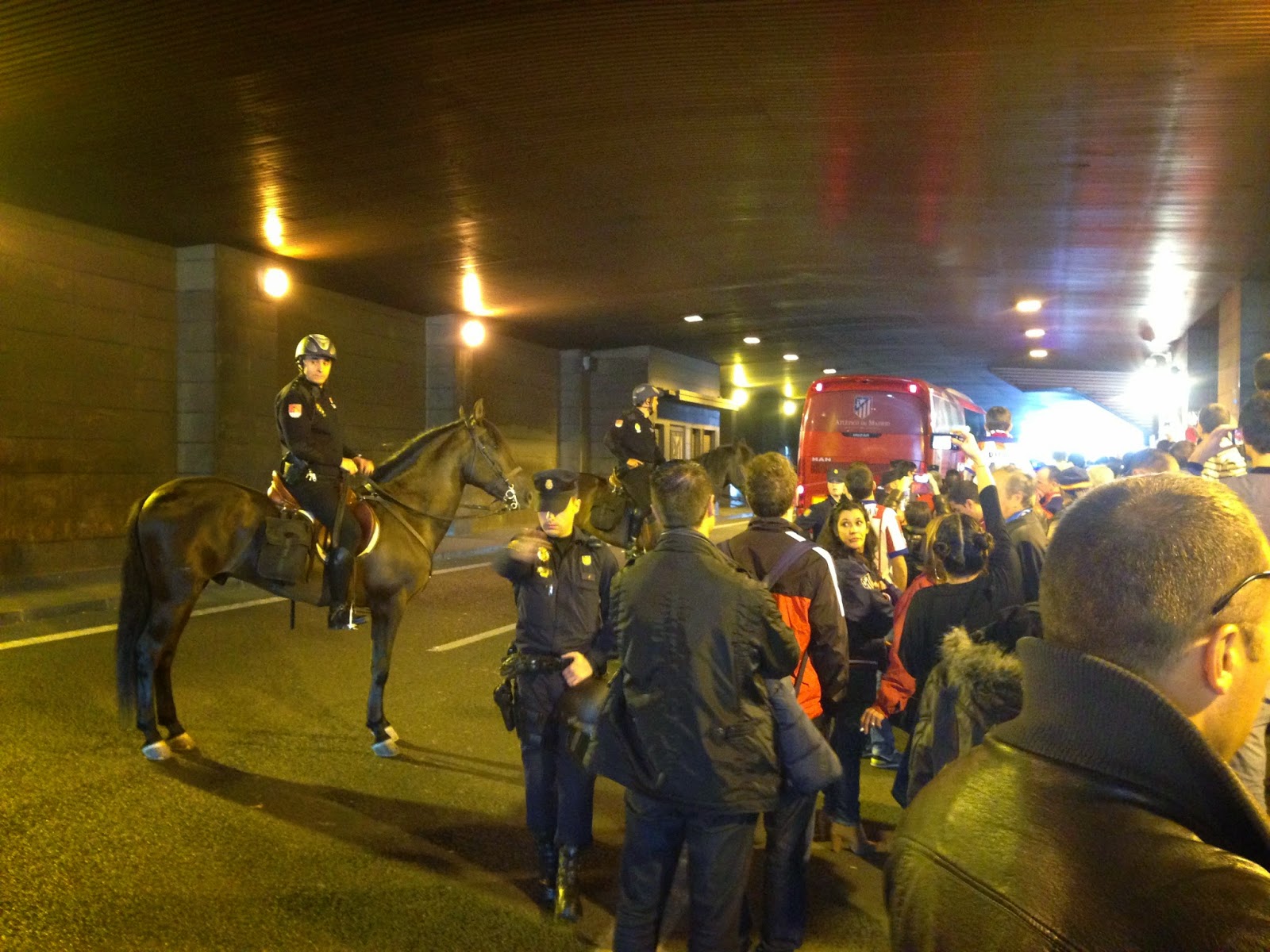
As if on cue, a battalion of police with batons and riot helmets hustle past me double time, as if they all just ate a plate of bad chorizo. They’re joined by two helmeted policemen on horseback, trotting around the end of the stadium toward the highway underpass beneath the stands.  This is it! I run after them with my camera, trying to listen for anyone yelling “DRUNKEN MELEE!!” in Spanish. Whatever that would be.


When I reach the underpass, lights are flashing in the tunnel and the police are shooing picture-snapping Atlético fans away from a red, white and blue bus parked under the stands. The Atlético team, apparently, has arrived at the stadium. 

Disappointingly, no one in the tunnel appears to be fighting, and/or drunk. Not even the players.

*          *          *

As I enter the stadium, the security guards give me renewed hope that the authorities at least believe chaos is just a smuggled-in smoke bomb away.  This is a far cry from the half-hearted bag check at American sporting events, where they seem most concerned about unauthorized umbrellas or a contraband bag of Dorito’s.


I’m not carrying a bag, purse or backpack, so instead I get a full-body pat down.  Not the perfunctory pat down you get at the airport if you set off the metal detector; I suspect this is closer to what you experience when you check in for your first day at prison. Another couple inches further up my leg and I’m going to ask the guard if he plans to buy me dinner.

Yes, that is a cell phone in my pocket. And no, I’m not just happy to see you.

*          *          *

I look at my ticket to figure out where I'm sitting. I see that my seat, apparently, is located in Vomitorio 34.  Which means there are at least 33 more vomitorios. Should I be concerned that my seat is located in a vomitorium? Is this somehow connected to the Oscar Mayer hot dogs they are selling across the street? Did I pay extra for this?

My seat, it turns out, is almost as far away from the field as it can possibly be without actually being located outside of the stadium. When I enter Vomitorio 34 and show the usher my ticket, she just laughs and points up the concrete stairs. As in “WAY the hell up there, Pal. Just keep climbing.”

Vomitorio 34, Section 519, Row 16, is in the second-to-last in the stadium, just under the press box. It might be in the shade, on some other day. But with the 4:00 p.m. start time I will be staring into a blinding sun for at least the first half of the game. I am baking in my warm up jacket and my scarf.


But by American standards, the seat is … not really that bad.  I paid 40 Euro for the ticket, about 50 bucks. At an American football game, I’d be sitting at about the 40-yard line, and paying what? Three or four times this price? And vomiting probably wouldn’t even be allowed, let alone encouraged.

I lean back, drape my arms over the adjoining chairs, and prop up my feet in the still-empty row in front of me. I feel like I’m living large, soaking in the sun and the scene through my Ray-bans in the vomitorio under the press box of Vicente Calderon Stadium. 

That is until the kids arrive.

*          *          *

Three things of note that have not yet been banned in Spanish football stadiums: cigars, children under the age of 12, and air horns. Thankfully they have not yet imported the vuvuzela.

It’s an odd sensation, having cigar smoke blown in your face. Kind of like being stuck on a motorcycle in the Holland tunnel in the middle of summer, behind a diesel tractor-trailer with a bad muffler.  I feel like I’m at a poker game, taking place in 1958.

The cigar smoke in this case comes from three seats down, billowing out of an 80-year-old man who apparently decided to treat his 27 grandchildren to a Saturday afternoon soccer game. Two of the kids – Kike and Pepe, I learn – are in the seats to the left of me.  Honestly I have no idea whether Kike and Pepe have any connection to the cigar-puffing, Fidel Castro impersonator. All I know is there otherwise seems to be a dearth of supervising adults in the general vicinity.

Kike and Pepe are at that age – I don’t know, 5? 6? – where they don’t really give a crap about the actual sporting event taking place on the field. Yeah there are a bunch of guys running around kicking a ball yadda yadda yadda okay we got it whatever. It’s much, much more fun for a boy at that age to throw peanut shells in the hair of the people in front of them, giggle and hide, and then puncture an eardrum by blowing an air horn.

Paula would never do this.

“Hey!”

Kike and Pepe have just blown their air horn into the ear of a visibly pissed Russian with a crewcut in the row in front of us.  The Russian kid apparently speaks no Spanish, so he begins yelling in broken English. To the delight of Kike and Pepe, who know just enough English to giggle and hurl back the insults of a six year old that transcend all cultural divides.

“What is your name?” Kiki asks the Russian slowly in English.
“Me, I am Nikolai.”
Kiki and and Pepe both laugh. “You’re stupid.”

Nikolai’s eyes bulge to the size of pies. For a moment I believe his head might actually explode. “I STUPID??? I STUPID?? YOU STUPID!! YOU!!”

The kids love this. They laugh and laugh and laugh. Meanwhile on the field, Atlético has scored its first goal. Kiki and Pepe could not possibly care less.

*          *          *

While the game so far may not have quite reached the level of a religious experience, I do notice about halfway through the first half that Jesus is sitting in front of me.


Turns out he’s an Atlético fan. I wonder how that is going to go over in Barcelona, and at the stadium across town.

*          *          *

Like the denizens of the Dawg Pound in Cleveland or the Cheeseheads in the end zone of Green Bay’s Lambeau Field, the serious fans – the inebriated ones with painted faces and life-long season tickets - sit at each end of the field behind the goal posts, with arguably the worst view in the stadium. 

Regardless of whatever is happening on the field, it appears that the primary activity behind the goal posts is to sing and chant in unison.  All kinds of chants, all kinds of songs. I can’t decipher a single lyric, but so far I have heard chants sung (or, perhaps, songs chanted) to the tune of “My Darling Clementine,” Scott Joplin’s “The Entertainer, and “Da Doo Ron Ron” by The Crystals.

Evidently the playlist at Vicente Calderon has not been updated since a decade or so before Franco died.

A few minutes before the end of the half, Atlético scores its second goal, further depressing the contingent of Malaga supporters relegated to the ghetto of a single section in the far corner of the stadium.  The Atlético fans stand and wave their scarves, as the end zone chants something to the tune of the Polovetzian Dance No. 2 by Borodin.

Back in Vomitorio 34, Nikolai continues his debate with Kike and Pepe.

“You stupid!!”
“No, you are.”
“No, you!”

 Jesus looks on impassively, and opens a bag of peanuts.

*          *          *

Midway through the second half. The Atlético fans are growing nervous, as Malaga kicks in a goal almost as if by accident, narrowing the score to 2-1.

It’s as if everyone is just waiting for a tie to ruin their afternoon.  Who wants to leave the stadium chanting “Yay! We didn’t lose to each other!”  What are the drunken-brawl chances in that?

Here under the press box, the niños are also antsy, but it has nothing to do with the game score.  There are, after all, only so many peanut shells you can throw and Russians you can annoy before boredom sets in.

Kike’s Dad finally makes himself known from the row behind us and steps in to try to put an end to the tormenting of Nikolai. My personal opinion is that anyone who argues with a six year old at a football game for 45 minutes pretty much gets what he deserves, but I’m also ready for the exercise of a little parental control.

“Kike,” Dad says, confiscating the air horn, “mira el partido.”  Watch the game.

The look on Kike’s face switches from unbridled joy to the grimace of a crushed soul, as if Dad just announced that there is no Santa Claus. Or whoever it is that delivers Christmas presents in Spain.

Watch the game? Am I being punished for a war crime? Why do you hate me?

After being prohibited from torturing foreign nationals, Kike initiates the sporting event version of Are We There, Yet?,  swiveling around every five minutes to ask Dad when the game will be over so they can get the hell out of there.

“Veinte minutos, Kike.”
“Quince minutos, Kike.”
“Diez minutos, Kike.”

Pepe on the sly tries to coax his friend into re-instigating hostilities with Nikolai, but Kike’s heart is just not in it anymore.  If you can’t deafen an innocent stranger with an air horn what’s the point, really?

With six minutes left to go Atlético scores another goal, making the game 3-1, the soccer equivalent of an emphatic beat down.

Scarves are waved. The end zone chants. Kike asks Dad how much time is left. Jesus sits quietly, eating his peanuts.

*          *          *

When the final whistle blows, Atlético walks away with a tidy victory, keeping them within striking distance of Real and Barcelona in La Liga standings. In all likelihood they won’t pass either of those teams, but stranger things have happened. Hell, they happened last year.

With the 3-1 route I hold out hope that humiliated Malaga fans will charge the field or set off a smoke bomb, something to provoke the riot police with the horses and clown cars. But defeat is accepted in a disappointingly civilized manner, as the boys in their blue and white jerseys obediently file from their segregated upper deck corner and out of the stadium.

The riot police look bored. The horses the police are riding look bored. The kids being dragged home may not necessarily be bored, but most of them clearly need a nap.

A fine Saturday afternoon in Madrid, unless you’re a Malaga fan.  The drunken brawl is still a week away.