I've been driving for about an hour from the Kayseri airport straight into the heart of Cappadocia when the scenery shifts from standard-issue, rolling-hill farmland into something straight out of Middle Earth. High cliffs and bizarre rock spires suddenly spring up around me in a landscape that looks like it was co-designed on a dare by Salvador Dali, Frank Herbert, and Dr. Seuss - after they dropped acid and followed up with a three-day drunk.
"Wow!" I say out loud, like a five year old let loose at Disney World. As there is no one in the car to hear me, I seem compelled to keep saying it again and again. Wow.
I stop the car on the side of the road. "Look!" I say out loud to no one, pointing up the side of a cliff. "A cave!"
Look, a cave? I sound like one of the Hardy Boys.
I will shortly learn that saying "Look! A cave!" in Cappadocia is the functional equivalent of driving into Iowa and saying "Look! Corn!" There are literally thousands of them. Tens of thousands. Carved into cliffs and rocks and underground caverns and lived in for centuries. People still live in them. Nearly every hotel room in Göreme where I'm headed is carved out of rock, including my own.
But I have been in Cappadocia for less than an hour, and right now I know none of this. I have located a cave! And I'll be damned if I'm passing up a chance to climb inside of it.
It's still winter and tourists are scarce; there are no other cars in sight. A cold misty rain is falling and the ground is slick. I'm not dressed for hiking or rock climbing. But I leave my car on the side of the road, hiking across the field and climbing over the rocks.
The rocks at this particular site are cone shaped, like the hoods of Grand Wizards at a Ku Klux Klan meeting. As I weave my way between the bizarre formations toward the cave, I would not be surprised by an appearance by the Star Wars' Sand People.
At first the cave looks impossible to reach, carved high into the cliff. But I spot a side entrance, accessible by a vertical climb that only looks quasi-dangerous. Yes, the shoes are all wrong; yes, the rocks are wet; yes, there is a quite a bit of scraping and sliding. But I make it up the side of the cliff, crawl through a short tunnel, and emerge into area that was once somebody's living room.
A flat rock sits in front the of the mouth of the cave, overlooking the valley below, like a giant bean bag chair in front of the biggest of big screen TVs. In the ceiling of the cave is an opening to another level, with more tunnels between more rooms like Habitrails for your pet hamster.
On the wall of the main room someone at some point in the past two thousand or so years has carved a symbol. It could be some long forgotten religious designation; it could be the Tree of Life. Hell, for all I know it's the family crest of the Flintstones.
I don't know what it is, but I take a picture of it anyway, because I find it amazing that such a thing exists. This won't be the last time that happens.
* * *
I have lived in Turkey for nearly a year and a half now, but it's time to go. My residence permit is nearly expired, and I have an unquenchable desire for certain things that Turkey can't give me. Namely edible Mexican food and affordable Irish whiskey.
As I'm leaving in less than two weeks, this trip to Cappadocia will serve as my Turkish farewell tour: one last chance to see the countryside, drink rakı, smoke nargile and mangle the language before heading home.
As I literally may never get the chance again, I'm planning to make the most of it.
* * *
The list of things I will wake up for at 4:30 in the morning, however, is a short one. The only ones I can readily think of involve my bed being on fire.
But if you want to go ballooning in Cappadocia, there is exactly one time slot available: sometime before dawn. I'm told this has to do with the lack of wind, but I'm not buying it. I think the Turks just secretly enjoy torturing tourists by getting them out of bed before the chickens wake up.
They arrive at my hotel at 5 a.m. to take me to the balloon ride. Given the ridiculous hour, the high cost of the ticket, and the fact that I'm being shoved into a van, I feel a little like the target of a kidnapping. Fortunately there doesn't appear to be any duct tape involved.
Not yet anyway.
The van drops me and a small group of sleepy, disoriented tourists at the offices of Voyager Balloons, joining what looks like a few hundred other sleepy, disoriented tourists. From what I can tell, other than me the only tourists willing to be rousted out of bed for a pre-dawn balloon ride are four and half foot tall Japanese women, and a few of their compliant husbands.
Voyager Balloons is serving breakfast, which consists of some hard rolls, a little cheese, and a few slices of unidentifiable, pink-colored meat. Even if the meat wasn't frightening, my stomach isn't awake yet; I opt for a cup of tea.
I notice one of the Japanese women has brought her own supply of ramen noodles to Turkey, apparently in case of just this kind of food emergency. She distributes the Cup o' Noodles to her friends, who receive the gift like manna from heaven.
After about a half hour we are herded back into the vans to be shuttled to the balloon launch site. It's light enough now that as we drive up we can see the balloons, lying on their sides like partially inflated beached whales. Baskets about the size of a Volkswagen bus are tied to each one. The Japanese ladies jump out of the van and begin snapping pictures. We are directed to our designated bus baskets and beached whale balloons. Each basket is divided into four compartments (plus room for a pilot, I'm relieved to see), and each compartment holds up to five people. My assigned basket compartment-mates are a young Japanese couple, now assigned by his company to live in India; and Adam and Dana from Orlando, Florida - perhaps the only other non-Japanese participants on the balloon tour.
"So, India," I say to my Japanese basket mate, Yoshi, to make conversation as we wait for the balloon to inflate. "That must be interesting."
"No!" he answers. "India is a terrible place! The electricity goes off in the middle of the day! The food is too spicy!" His wife, who seems to understand little else, nods emphatically at the India bad-mouthing.
"We leave India every chance we get," Yoshi continues as we climb into the basket. "This is why we are now in Turkey."
I think of telling Yoshi of the times the electricity in my Istanbul apartment has gone off in the middle of the day, but think better of it. The food is not spicy in Turkey, so I guess he kind of has a point.
The balloon pilot is explaining our "landing position" instructions to Adam, Dana, me, and the 17 Japanese people the basket. The instruction are in English. I'm wondering if "crouch down and grab the rope handles" possibly can't be translated.
The sun now is up and we stand waiting in our giant basket. Suddenly and without further instructions, I find myself floating in the air.
* * * Maybe one of the biggest surprises living as an ex pat in Turkey was how ordinary and unoriginal this decision turned out to be. There are literally tens of thousands of (mostly European) foreigners living in the country, and you run into them everywhere: Germans, Russians, Italians, Brits, and more Americans than you might think.
For the most part, I and the rest of the yabancı do our best to blend in. But there are notable examples of the contrary.
Last fall a German acquaintance was nice enough to offer to let me stay at her currently-empty apartment for a week in a town in southwest Turkey called Didim. She had bought the apartment as "an investment," she told me, but 11 months out of the year she was elsewhere and the place sat empty.
As I could see on a map that the town was located on the Aegean Coast, it sounded too good to be true. I set off in a bus to Didim, with thoughts of - who knows? - maybe I'll move there.
It was too good to be true. Didim turned out to be far and away my least favorite place in all of Turkey. Perhaps the entire world.
Imagine Corpus Christi, Texas but not even a nice part of Corpus Christi, Texas. Like North Beach without a beach. Or an ocean.
The sea, in fact, is miles away. Didim itself is inland, consisting of long, flat, treeless, shadeless, desolate stretches of land and an endless number of cookie-cutter, concrete apartment/condo developments. Many developments sit half finished, investors apparently taking their money and moving it somewhere less depressing. Abandoned complexes are spread throughout town, separated by empty, weed-filled lots.
The actual Turks in this city seem to be in hiding, replaced by a population of loud, pasty, overweight, non-Turkish-speaking, middle-class British people, who apparently are so desperate for sunshine that they will soak it up wherever they can, no matter how god forsaken.
The restaurant choices near the flat consist of two British pubs, and an "Italian" pizza parlor. I check out the pubs. Every customer is a Brit well past their 55th birthday. Most appear to be drunk; all appear to have eaten their share of shepherd's pies. Rod Stewart's Greatest Hits plays from a speaker over the bar in a continuous loop.
This doesn't feel like I am in Turkey. It feels like I am trapped in somewhere between "The Benny Hill Show," and one of Dante's Seven Circles of Hell.
Back in Cappadocia the ex pats are not nearly as conspicuous, but I still have no trouble stumbling right over them. In the little town of Göreme I walk down the hill from my cave hotel straight toward an establishment called "Fat Boys," politically incorrect down to its fat boy logo, which appears to be a white-washed version of Fat Albert from The Cosby Kids.
Inside a group of men banter in English around a pool table. One of the men is large enough that I incorrectly assume he must be the bar's namesake. In two of the four corners of the room there are couches and chairs grouped together like the faux living rooms of a furniture store.
On the wall I see the flags of Tibet, Brazil, Australia, and - inexplicably - Minnesota. Two women sit at a table in the middle of the bar, loudly lamenting the price of gasoline with cockney accents straight out of "My Fair Lady."
I wasn't looking for the ex pats, but it looks like I found them anyway.
I'm greeted in English by a man whom I spot immediately as a local. He seems pleasantly surprised when I answer and place my order in Turkish. I later learn that this is Yılmaz Şişman, the owner of the bar along with his Australian wife, Angela. Yılmaz's name, roughly translated into English, means "Indomitable Fat."
And that's how you legitimately get to own a bar in Göreme, Turkey called Fat Boy's.
The billiard tournament continues and Eliza Doolittle and her friend are still yammering on about gas prices. But Yılmaz is friendly and lets me practice my Turkish without shame. The beer is cold, and the soccer match will be starting soon on the big-screen TV.
I decide I can live with a little English yammering in the background. I fluff up the cushions of my couch and - in Turkish, of course - order another Efes Dark from Mr. Indomitable Fat.
* * *
Day Five of the Cappadocia Farewell tour. Winter has returned and the day is grey, snowy and cold. I decide this is as good a time as any to check out some of Cappadocia's 36 famed underground cities. If nothing else, I reason, the Underground People knew how to get out of the wind.
I drive to the town of Kaymaklı (inexplicably translated into English as "creamy"), where unfortunately the Japanese tour buses have arrived before me. Apparently it is Spring Break in Japan, and the underground city is filled with gaggles of young Asian women, giggling and making peace signs as they endlessly pose for pictures next to every possible underground archway.
It's like a clothed, less-drunk, Japanese version of Girls Gone Wild.
After my second underground city in Derinkuyu I've decided that I pretty much get the idea: people lived underground, and crawled through a lot of tunnels. My back hurts from bending and stooping. Here's one place I have discovered where being a tiny Asian woman has a distinct advantage over being a tall middle aged white guy.
I'm cold, tired, and hungry, and - call me what you will - what I really want is a big steaming bowl of caffe latte. But seeing as the nearest Starbucks is several hundred miles away, I leave the underground city and wander into a nearby business that seems to be a combination tea house/souvenir stand.
Inside I see only two older Turkish men, and a head-scarfed woman. There is not a tourist in sight. But there is a fire in the pot-belly stove in the middle of the room, and right now "warm and dry" looks pretty good to me. I take off my coat and order a tea.
The men resume speaking in Turkish after taking a moment to look me over. One resumes his apparently ongoing complaint about the general dearth of tourists, other than the buses full of Japanese who apparently don't frequent his tea house. I interject from the neighboring table, in Turkish, that maybe it's still a little too cold. They both look up at me in surprise, as if by some miracle the child long believed to be deaf and dumb has finally spoken.
You speak Turkish? one of the men asks me. Where are you from? I see he is a religious man, wearing a skull cap and fingering a string of prayer beads.
I'm American but I've been living in Istanbul, I tell him. Your Turkish is very good, he says to me. I know he's just being polite but I thank him anyway. It's not nearly as good as he thinks it is as he begins pontificating in Turkish, assuming that I understand what he's saying. I'm catching maybe 40 percent of it. Maybe.
He seems happy to have someone different to talk to; maybe his wife and friend have heard it all many times before. He's telling me about the weather and the history of the underground cities and all the different people who have lived throughout the centuries in what is now Turkey: Hittites, Romans, Jews, early Christians, modern Muslims.
I'm getting a little worried as his monologue turns to religion. He is still fingering the prayer beads, the vocabulary is moving out of my range of ability. But he has a point he wants to make.
There are four great books, he tells me: the Torah, the Bible, the Koran, and one other I either can't understand or never heard of. But all of these books, he is telling me, come from the same place.
Do I know Adem and Havva? he asks me. I look at him confused, thinking maybe these are friends of his from Istanbul I might have come across. I shake my head. Adem and Havva, he repeats. From the bible.
The lightbulb goes off. Adem and Havva. Adam and Eve. Got it.
Adem and Havva are the parents of all us, he tells me. Arab, Turk, American. Muslim, Christian, Jew. This is why I don't understand wars, he says. We are all the same family. Why are we killing each other? Why are we killing our own family?
I smile, because I understand and agree with his point. But I don't know the answer to his question, and I tell him so.
He looks at my empty tea glass and asks me if I would like another, this one is on him. A glass of tea costs about the equivalent of 55 cents. I thank him and accept the offer, happy that I wandered off the path in this unexpected direction.
* * *
When I was back in the States in December my friend Mark bought me a knife for Christmas. To fully appreciate how absurd this is, you'd have to know me, and my friend Mark. I'm not sure what a "Knife Guy" looks like, but I'm reasonably sure he doesn't look like either one of us. Outside of the kitchen cutlery drawer, I'm not sure I ever owned one.
The gift knife was way beyond the wimpy Swiss Army variety. With a wooden handle and a four-inch flip blade, this looked more like something I'd take with me to a rumble under the Interstate. I had to look at the address on the label twice after opening the package to make sure it wasn't some kind of UPS shipping mistake.
"I have one just like it," Mark later told me, explaining the gift. "I take it hiking, and use it to cut up apples."
See, if I'm out on a hike and I want to eat an apple, I'm probably just going to bite it with my teeth, but okay. Thanks, Mark, I said, and Merry Christmas. I threw the knife in my checked luggage and headed back to Turkey.
Upon returning to Istanbul from Cappadocia to pack up my life, I have the bright idea to put all the heavy things in one carry-on bag. This way, I tell myself, they won't me charge me for exceeding the checked baggage weight limit!
I am so, so, so smart. I mindlessly empty the "heavy things" from my office and desk drawer into the carry-on luggage.
The morning of my departure I'm feeling pretty good about myself for getting to the Istanbul airport with three heavy-ass bags, checking into British Airways while incurring only a $60 bag charge, and easily clearing passport control. The good feeling, unfortunately, lasts only until my carry-on bag goes through the x-ray at the security checkpoint.
"Sir," the female security agent says, stopping me. "Is this your bag?"
Before I originally left for Turkey, multiple smart-ass friends with even less knowledge about the country than I gave me some version of the following: "Turkey? How could you go to Turkey? Didn't you ever see Midnight Express?"
How ridiculous, I would reply. You're judging an entire country based on a 30-year-old prison movie? It would be like saying "How could you go to America; didn't you ever see Silence of the Lambs or Beach Blanket Bingo?"
Besides, I proclaimed confidently in my very first blog entry: "I have promised all concerned to avoid the issue entirely by not having heroin strapped to my body as I arrive at customs."
Good plan. It's a shame I didn't say the same thing about knives.
"You have a knife in your bag?" the security officer asks me.
"A knife? I answer, in the same tone I would if she had asked me if I had a marmot in my pants. "No! No, of course I don't have a ..." Oh crap.
She unzips the bag and paws through the desk detritus before pulling out Mark's Christmas gift, holding it out in front of me just in case I wanted to deny it again.
"Oh. That knife."
Okay quick, I say to myself: try not to look like a terrorist, try not to look like a terrorist, try not to look like a terrorist ... Dammit! Why did I grow this beard?
She unfolds the four-inch blade from the wooden handle and brandishes it toward me. It's pretty clear that Mark's apple slicer is several steps beyond the prohibited box cutter.
"Sir," she says to me, "this is a problem."
This has turned out well, I think to myself. I joke in my first blog entry about Midnight Express, and I'll get to write the last one from inside an actual Turkish prison! Now there's some irony for you.
"I'm sorry," I say to the officer. "I thought that was in my checked luggage. I had no idea ..." I wonder if I'm going to be forced to explain the Christmas gift/apple slicer story in Turkish. "Really really really sorry."
She continues to hold the knife out in front of me, now grasping it between two fingers like evidence in a murder trial. I wait for her to tell me follow her to the interrogation/beating room, and hold my breath.
"We're going to have to take this," she says finally.
I exhale. Yes please, take it! I'm sure I can find another way to eat apples in the wilderness without violating international criminal statutes.
"Thank you," I say as I pack up my crap and slink off toward my gate. I say it more than once, I'm sure.
I take this as a sign that it really is time to go home.
Don't tell anyone, but there is a gap in the fence on the hill separating a remote section of Istanbul's Maçka Park and the Küçükçiftlik Park concert grounds. This being Turkey, someone probably intentionally tore this portion of the fence down a while ago. And this also being Turkey, of course no one has gotten around to repairing it yet. I noticed the gap in the fence one day as I was jogging through the park, which seems to be in a perpetual state of reconstruction. If I was a responsible person, my first thought probably would have been, "You know, they really need to fix that. Somebody might get hurt." Being an irresponsible person, however, my first thought was actually quite different. "Finally," I thought to myself, as I jogged past the fence and back up the hill. "A ticket to the Stevie Wonder concert I can actually afford."
* * *
Let me state for the record that I am not a fan of the outdoor festival/stadium concert. At least not any more. The last time I attended one was to see U2 at Pittsburgh's Three Rivers Stadium, a concrete, AstroTurf-covered monstrosity so horrible for viewing anything that it was imploded and bulldozed more than a decade ago.
I remember spending that U2 concert in one of the stadium's mezzanine seats, located approximately four and half miles from the stage. My seat also was unfortunately located behind a large, drunken woman in an ill-fitting tank top, who stood the entire show with her arms in the air hollering "WOO-HOO!! BONO!! UP HERE, BONO!! WOO!! WOOOO!!"
Yeah, like he can hear you. "I LOVE YOU, BONO!! MARRY ME, BONO!!" And like you've got a shot. Sit your ass down. "WOOO!!" And for God's sake: Shut. Up!
After this experience I decided that as far as live music was concerned, I'd rather go listen to an unknown jazz trio in a small night club than to see the Greatest Stars in the History of Recorded Music in a cavernous football stadium.
Yes, this ruled out seeing out a lot of mega-acts that don't perform live unless fireworks can be set off during the show, but frankly I was old enough not to care any more. I'd seen Springsteen, I'd seen The Rolling Stones. Lighters over the head, exploding drum sets, lines at the outdoor chemical toilets ... yeah, thanks but, I think I'm done.
Yet the idea of seeing Stevie Wonder in Istanbul - playing in a large, outdoor concert venue - was something else entirely. More of a concept than a concert, really. This was a chance to say for the rest of my life, whenever the subject came up at cocktail parties: "Stevie Wonder? Oh yeah, he was great. When I saw him in Istanbul."
The chance to say that, forever? You tell me, what are the odds that someone at the cocktail party is going to top that?
The chance to say something like that is so good, it's almost worth paying for.
I said almost.
* * *
Honestly, I had no clue whether the hole in the fence scam was going to work at all when I headed out the door on Friday night. There were all kinds of reasons to believe it wouldn't. Cops patrolling the park? A tarp over the fence? Security guards waving people away and saying "there's nothing to see here," in Turkish?
I really wasn't even sure that from the angle you could actually see performers onthe stage. (Yes, I probably should have looked into that.) No matter.
I had already packed two frosty bottles of Efes into my computer bag. I figured the worst that could happen is that I would miss the concert, but still have the chance sit in the park and drink beer by myself like a hobo.
Except that, damn, I forgot my brown paper bag.
By the time I walk to the end of the park and reach the gap in the fence it is about 8:30. Already about a half dozen people have planted themselves in front of the gap. An older man is sitting on what looks like a tree stump. Several adolescent boys have staked a claim to a front-row seat on a wooden pallet.
True, no one was going to mistake this for one of the luxury boxes at Cowboys Stadium. But looking at the view through the fence, I'll be damned if from this spot you don't have a pretty good shot of the stage, at a distance that is not really that far at all.
Honest to God. If this was a U2 concert in Pittsburgh, these seats would be going for $75 a pop.
On the downside, I notice the people there when I arrive have stopped talking and are looking at me suspiciously, like I just walked on to the wrong gangs' turf. In the dark it's hard to tell whether this an enterprising group of Stevie Wonder fans, or nothing more than a well-located gypsy camp.
Is there another place to sit, maybe?
I look behind me to see a hillside, recently re-sodded during the on-going park restoration with lush, thick, green grass. I walk away from the fence and up the hill, then turn and sit to survey the scene.
This is it; I have struck freeloaders' gold.
While the concert has yet to start, I can hear the pre-show recorded music perfectly. There is no one around me, and from this high spot I have an absolutely clear view of the stage below. This is unbelievable, I think to myself. Why I am the only person in Istanbul to have figured this out?
As I lie back on the grass, reach for my beer and wait for Stevie Wonder to appear, I have concluded that I truly must be The Smartest Boy in the World.
That is until maybe 30 seconds later, when the Istanbul Parks Department turns on the lawn sprinklers.
* * *
I would be lying if I told you I was born a Stevie Wonder fan. I grew up outside of Cincinnati, Ohio, in the WASP-iest, whitest of white, Wonder Bread suburbs. Our idea of exposure to "ethnic culture" was watching the Catholic families from Guardian Angels go to mass early in the morning and eat fish on Friday.
For this reason Stevie Wonder and Motown was not really the music the kids at my school were listening to. In fact anyone caught listening to anything with more soul than Sammy Davis Jr.'s "The Candy Man" was immediately sent home from school and placed on three days' suspension.
But when I was 11 years old, I bought a 45-rpm record of Stevie Wonder's song, "Superstition." Of course the funky drum beat intro pulled me in, but it was the riff with the electric clavichord that really hooked me. I'd never heard anything like it before, and if I think about it, I'm not sure I've heard anything like it since. Then you throw in the pulsating three-piece horn section, and Stevie's iconic wail after the bridge?
I played the grooves off of that record.
To this day, I think "Superstition" is one of the coolest, hippest, most unique-sounding pop records ever made. As is the mark of all great songs, it never sounds dated. In the game where I'm cast away to a desert island and get to take ten records with me? This definitely makes the cut.
After about 1980 or so, honestly I think a lot of Stevie Wonder's music became sugary and a bit over-commercialized. "Part-time Lover," "Overjoyed," and "I Just Called to Say I Love You," for example, have been banished from my iTunes play list, as I am worried about the risk of developing Type II Diabetes.
But the Stevie Wonder of the late 60s and early 70s, IMHO, was absolutely cooking. Download "Talking Book" or "Innervisions" sometime and you'll see what I'm talking about. This guy had already earned his place in the Pantheon of Popular Music before I had made it to junior high school, and he wasn't going anywhere.
Yet in a career that literally spans 50 years (he started in 1962, when he was 12), Stevie Wonder had never once performed in Istanbul, or any else in Turkey, until now. And as luck would have it there was a hole in the fence, just above where he was going to do it.
* * *
My shirt has almost dried out by the time Stevie takes the stage around 9:30. I managed to survive the lawn sprinkler incident losing only my dignity, as I ran down the hill serpentine, dodging water jets and clutching my beer bag like I was in an Indiana Jones movie.
A crowd of about 20 to 30 people has now gathered at the hole as the concert starts. I have staked out a spot on the ground several yards away, between a scraggly tree and a large pile of yet-to-be installed paving stones. I decide to just sit for a while and listen before trying to jostle for a spot at the fence.
As the show opens both Stevie and the Istanbul crowd seem genuinely delighted that he's here. He gets halfway into his first song (Marvin Gaye's "How Sweet It Is") before telling the crowd that he wants to say "hello in your language." Someone apparently whispers in his ear, and Stevie repeats an imperfect but still understandable "merhaba!" "Merhaba!" the crowd shouts back. Stevie says it again. "Merhaba!" "Merhaba!" comes the response. He does it yet a third time. "Merhaba!"
Okay, this is cute and all, but I'm starting to get a little uncomfortable, realizing this is how the conversation would sound anywhere in Turkey if you were training your parrot.
"Merhaba!" Jeez, not again. "Merhaba!"
"I love you!" Stevie says in English. Someone on stage feeds him the line in Turkish: Ben seni seviyorum.
"Been ... sinning several of 'em."
Oh, Lord. Stevie please just sing.
I get up now and walk to the fence to join the rest of the freeloading crowd, which I notice is starting to grow a little restless. Several have turned away from the stage to light cigarettes or play with their dogs. What's going on right now is, you know, not particularly easy to dance to.
"Merhaba!"
Okay, Turkish banter is not the man's strong suit. Fortunately it doesn't need to be. He leaves behind the Marvin Gaye cover and shifts into his own reggae-flavored classic, "Master Blaster," then takes it up a notch with Innervision's "Higher Ground."
After an unfortunate deviation with a tribute to Michael Jackson and the aforementioned "Overjoyed" (or as I think of it, the Air Jordan shoe commercial theme music), Stevie gets back on track with "Ma Cherie Amour," and "Don't you Worry 'Bout a Thing." By the time he gets to "Signed, Sealed and Delivered," the whole place is dancing, singing along, and eating out of his hand.
Up here at the fence, the kids are loving it, too. Truly, most of them are kids, relatively speaking, with a median age hovering in the mid 20s. It occurs to me that the last time Stevie Wonder had a hit single, most of these people were not even born. Yet here they are, with me at the fence, essentially sneaking into their grandfathers' concert.
Just behind the crowd stands a weather-beaten tree. Two or three boys have climbed up the tree trunk for a better view. In the middle of "Sir Duke," one of the tree-branch boys inexplicably begins to yelp. No, really; this is a yelp like the yelp of a schnauzer, trapped in a closet somewhere.
Whether this is an expression of approval, derision, or Tourette's really is impossible to determine. But let's go with approval, as down below the trees, the kids are now dancing, cigarettes in one hand and beer cans in the other.
Stevie is giving the concert crowd what it wants as he cranks out "I Wish," "If You Really Love Me," and "Boogie On, Reggae Woman." But I look at my watch, and it's after 11:00 now. And I'm still waiting.
Then I hear it. The lead-in drum beat starts, then a cheer goes up when Stevie hits the first notes on the clavichord.
I reach into my computer/beer bag and pull out the last of two bottles of Efes. I take a swig of the beer as the Turkish girls nearby dance on the wooden pallet. One of them reaches over with her beer can, and clinks my bottle.
Four decades after I first played the 45 record on the floor of my bedroom, I hear Stevie Wonder belt out the lines of "Superstition," live, as I stand peering over a fence on a hillside in Istanbul, Turkey.
Now isn't this just the damnedest thing.
"When you believe in things that you don't understand Then you suffer ..."
You have to feel a little sorry for the hostess at Bistro Floyd, stationed here nightly at the ugly underbelly of international tourism. "What language do you speak?" the hostess asks us in English as we stand at the entrance of the Dutch restaurant.
"I’m Swedish," Ola tells her, "but I also speak English, Dutch, some German ..." "Yes, I speak English, too," I say, chiming in, "but also a little Turkish, some French, not a lot but I can get by ..." The hostess holds up her hands to stop us. I think she might next ask for our favorite color, or a description of what we would do if she were an ice cream cone. But no, apparently we are not on The Dating Game, and she's not looking for a recitation of our Curriculum Vitae. "I just need to know what menu to give you," she says. "We have Dutch, Swedish, Danish, Norwegian, German and English."
Notably, Turkish is not mentioned as a menu option. "You want English?"
Sure, let’s go with English. What country are we in again?
* * *
Welcome to Alanya, quite possibly the most un-Turkish place in all of Turkey.
Although purporting to be a Turkish city of some 100,000 on the Mediterranean coast, in August at least, Alanya is something else entirely. Currently this is a city populated almost exclusively by Danes, Swedes, Norwegians and Finns: mostly tall, blond, blue-eyed and under 25, all with their Scandinavian skin toasting to a rosy red. Outside of the shop owners, good luck finding any Turks to talk to in Alanya. You have a much better chance of sitting at a table next to Bjorn Borg, or one of the original members of A-ha. Don't get me wrong: I love Scandinavia. I just never expected to find it located on the southern coast of Turkey.
* * *
I know Ola from a year spent long ago at a university in Brussels, Belgium. I was there faking my way through a program in "International and Comparative Law," information that ever since has been gathering dust in the back-room filing cabinets of my brain.
Ola and I actually had gone to the Bistro Floyd our second night in Alanya with the twisted, nostalgic hope that a Dutch restaurant on the coast of Turkey might possibly be serving Belgian beer.
They were, in fact. Let's all drink to the Free Movement of Goods and Alcohol. Ola now lives back in his home country of Sweden, in the southern town of Malmö. In recent years he’s become quite the scuba diver, periodically posting envy-inducing underwater photos on Facebook from places like Malta and the Egyptian Red Sea. While I haven’t seen Ola in more than a decade plus, several weeks ago he wrote and told me he was planning a scuba-diving trip to Alanya, on the southern coast of Turkey. He knew I was in Istanbul, which he realized was not exactly close by. But he invited me to join him anyway because both places are in Turkey (technically), and, as he put it, "you seem to get around." I seem to get around. Say what you will about me, Spandau Ballet, but I know this much is true.
Scuba diving in Alanya? I'm not exactly sure where Alanya is, but what the hell, Ola.
Wake me up before you go go.
* * *
As long as I am shamelessly throwing out 1980s song-lyric allusions, you may ask yourself (last one, I promise): do I even know how to scuba dive?
Don't be ridiculous. Of course I know how to scuba dive.
That is to say, I used to know how to scuba dive, much in the same way that I used to know how to solve an algebraic equation. You know, back in the ninth grade.
With one exception, all of my previous scuba diving experience pre-dates the current century. I figure it's all like riding a bicycle, which is basically correct. Except that the design of the bicycle has changed a bit during the past few decades.
Ola looks at me with disbelief on the dive boat, for example, as I search for a place to manually inflate my buoyancy vest. Yeah, we hook that up to the air tank now, Grandpa.
And yes, I am only marginally humiliated when the Turkish female dive guide, Aşkım -- literally in Turkish, "My Love" -- informs me that I am putting my wet suit on backwards.
Damn kids and their crazy new wet suit fashions. When did they start putting the zipper in the backs of these things? Apparently sometime just shortly after the cancellation of "Sea Hunt," but never mind.
So I'm Old School. Or perhaps I'm just old. No matter. I don't care what My Love says, I still look damn good in a backward wet suit. * * *
No one can really give us a good answer as to exactly how or when the Scandinavians took over Alanya. The driver from the airport tells me it used to be Germans, but they've now mostly moved on to other places.
Americans and Brits seem completely non-existent, as do the French, Italians and Spaniards. The Russians go to nearby Antalya. The Turks pretty much stay away in the summer all together, opting for Bodrum and Fethiye and other spots along the coast farther west.
That apparently gives the fair-skinned Nordics a clear path to invasion, overwhelming Alanya through continuous waves of direct charter flights from the north. By mid August the population is so blond that I'm pretty sure Alanya would be able to field an internationally competitive hockey team.
But it's not just any Scandinavian who is coming to Alanya. Those Scandinavians who are married, child-laden, middle-aged or elderly apparently are stopped at the border, or have found something else to do on holiday.
No, instead Alanya seems specifically designed as giant Scandinavian Club Med for blond-haired, blue-eyed twenty-somethings, looking to spend a couple of weeks in Turkey with their friends getting tan and/or drunk.
Or laid. Preferably all three, I'm sure.
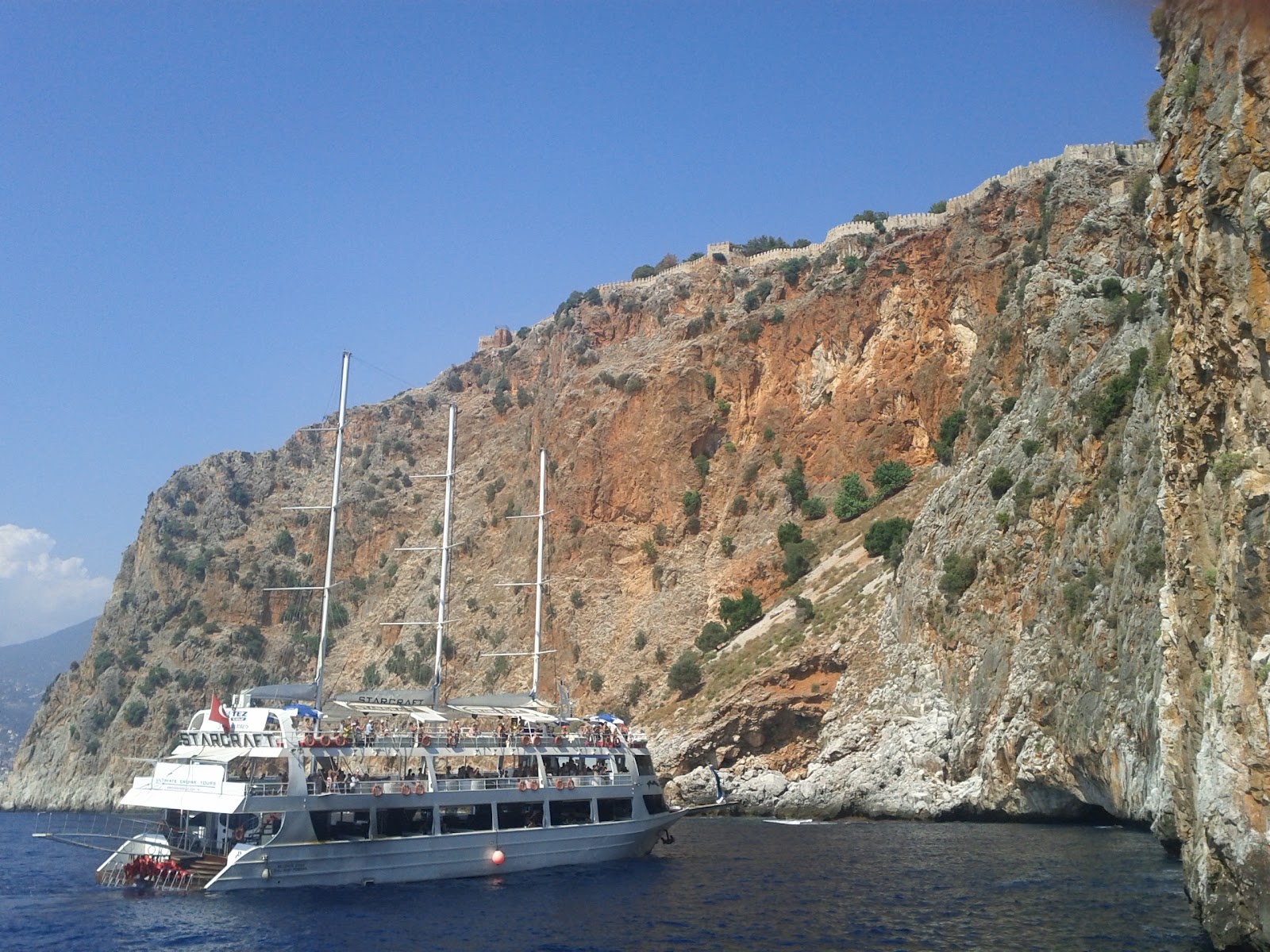
The harbor of Alanya is lined with massive, multi-decked party boats -- ships, really -- designed to pack in several hundred young adults, ply them with alcohol, deafen them with disco music and ship them out to sea.
Some of the boats appear to have sailed straight out of Disneyland, designed to look like a Viking knarr, or a pirate ship. Or sometimes, what the hell, let's just cover all our bases and make it ... like ... a Viking Pirate Ship!
One company, the "Big Baba Boat Tour," advertises a daily "foam party," where soap suds bubble out of a pipe above the deck alongside the reflective rotating disco ball, as the dance music thumps away.
The party continues until someone vomits, slips and falls off the boat, or drowns in the rinse cycle.
Remember those great parties you used to have in college, where you'd pour a box of powdered detergent into the Laundromat washing machine and set the dial to "spin?"
Yeah, me neither.
Keep in mind, we are in an overwhelmingly Muslim country, smack in the middle of the holy month of Ramazan. Two weeks earlier I had been in the slightly more religiously observant city of Bursa, where it was nearly impossible to find someone to sell us a single beer, even after sundown.
In contrast, the first business I see after arriving in Alanya belongs to a 24-hour liquor store located a block from my hotel, with the unambiguous name of "Hello, Alcohol!"
It may be Ramazan, but I assure you, there will be no problem here getting a drink.
In addition to the party boats, the harbor area of Alanya is lined with non-floating discos and tourist restaurants selling the Cuisine of the Young: pizza, pasta, hamburgers, and -- for reasons I still can't explain -- "Tex-Mex."
I will admit, the last thing I ever expected to find in Turkey was a table of Norwegian frat boys devouring a tray full of Ultimate Nachos.
Perhaps now I truly have seen everything.
* * * Back on the dive boat, we've had lunch and are headed back to the cliffs for our afternoon dive. There are 16 divers on the boat -- mostly Scandinavian, of course -- with a few Germans and assorted other nationalities sprinkled in.
For the crime of speaking neither Swedish nor German, My Love has teamed me as a "dive buddy" with Pavel, a gap-toothed, slightly pot-bellied, Speedo-clad Eastern European of otherwise undetermined origin.
Pavel doesn't understand English and I have no idea what he is saying to me, but My Love figures this shouldn't be a significant problem breathing out of a scuba tank 30 feet underwater.
True enough. But what is a problem is that you are supposed to swim along with your Dive Buddy and keep an eye on them in case a problem develops. My Dive Buddy, however, has an apparent inability to stabilize his underwater buoyancy. Pavel spends the majority of the morning dive continuously inflating and then de-flating his buoyancy vest, floating above and sinking below me like an underwater yo-yo.
Leading the group underwater, My Love keeps pointing to me, then to her eyes, then drawing her two index fingers together. This is the official scuba diver signal for "Keep your eye on your Dive Buddy!" I respond with the unofficial yet internationally recognized palms out and shrug of the shoulders.
I'm trying, My Love. Believe me I'm trying.
I keep looking around for Pavel, above me or below me, and then signaling to him with a forward wave of my hand and pat on my hip, like I'm trying to convince a stray dog to follow me home.
"Come on, Pavel! Come on, boy! Up here, Pavel! Look, look! Let's go, Pavel! There's a treat back at the boat! Come on!"
Despite the compatibility issues, in the afternoon Pavel and I are back together again, re-uniting for one more dive. We're like Hall & Oates, or Prince and Apollonia. Slightly less talent, yes, but with approximately the same number of Speedos.
The dive boat anchors in a secluded cove for an afternoon of cavern diving. Both the water and sky are beautifully clear and blue. As we climb back into our wet suits (zipper in back; hey, I remember) and strap on our tanks, the only sound are the waves lapping against the boat and the rocks of the nearby cliff.
It's all quite idyllic and amazing. I would swear I was in a Jacques Cousteau film, if only Pavel wore a stocking cap and spoke a little French.
Just then I notice something off in the distance, at first not so much a sound as a ... sensation. A throbbing sensation. Like the throbbing of the vein in your forehead, at the beginning of a particularly memorable migraine headache.
The throbbing sensation slowly becomes audible. Then I see the source of the throbs, rounding the cliffs and sailing into our cove.
One of the party boats -- not of the Viking/pirate ship variety but a party boat all the same -- cruises around the bend and puts down anchor less than 50 yards away from the dive boat. Music of course is blaring from the giant, IMAX-quality loud speakers housed somewhere on board.
Even though it’s scarcely past noon, bikini-clad Scandinavian twenty-somethings are already dancing on the deck, plastic beer cups held high. Several revelers immediately leap -- or perhaps stumble -- off the ship's deck into the water below, squealing all the way. Just like that, the idyllic dive cove becomes Paradise Lost, as if someone has towed in a fully-operational disco into your back yard on a Sunday afternoon while you were napping in the hammock. The speakers on the boat thump out a continuous stream of ... okay, let’s call them "songs," all with the same throbbing, non-stop techno beat, and just a slight variation of the following lyrics: "I’VE GOT TO PARTY, PARTY!! I’M GONNA TO PARTY, PARTY!! SHE WANTS TO PARTY, PARTY!! THEY NEED TO PARTY, PARTY!! WE HAVE TO PARTY, PARTY!! ..."
The subtleties may be lost on you, but I think you get the general idea. An apparent drunken attempt to conjugate the verb, "to party."
Okay, now everyone together: the future conditional! "WE MIGHT JUST PARTY, PARTY!! ..."
Pavel and I both stare dumbfounded at the party boat for a few moments, then strap on our fins and step off into the water. There is nothing really to say. As far as I know, there is no official scuba diver signal for "Let's go before they start doing Jell-O shots."
The party boat is still there when we surface 45 minutes later. But things have progressed, as they are now playing "The Chicken Dance," (or as we say in Swedish, "Fågeldansen"), the international signal that everyone at the wedding reception is drunk enough to dance around tables flapping their arms like a chicken.
Say what you will about these people, but even with polka music, they know how to party, party.
I have a feeling suds from the overflowing washing machine can't be far behind.
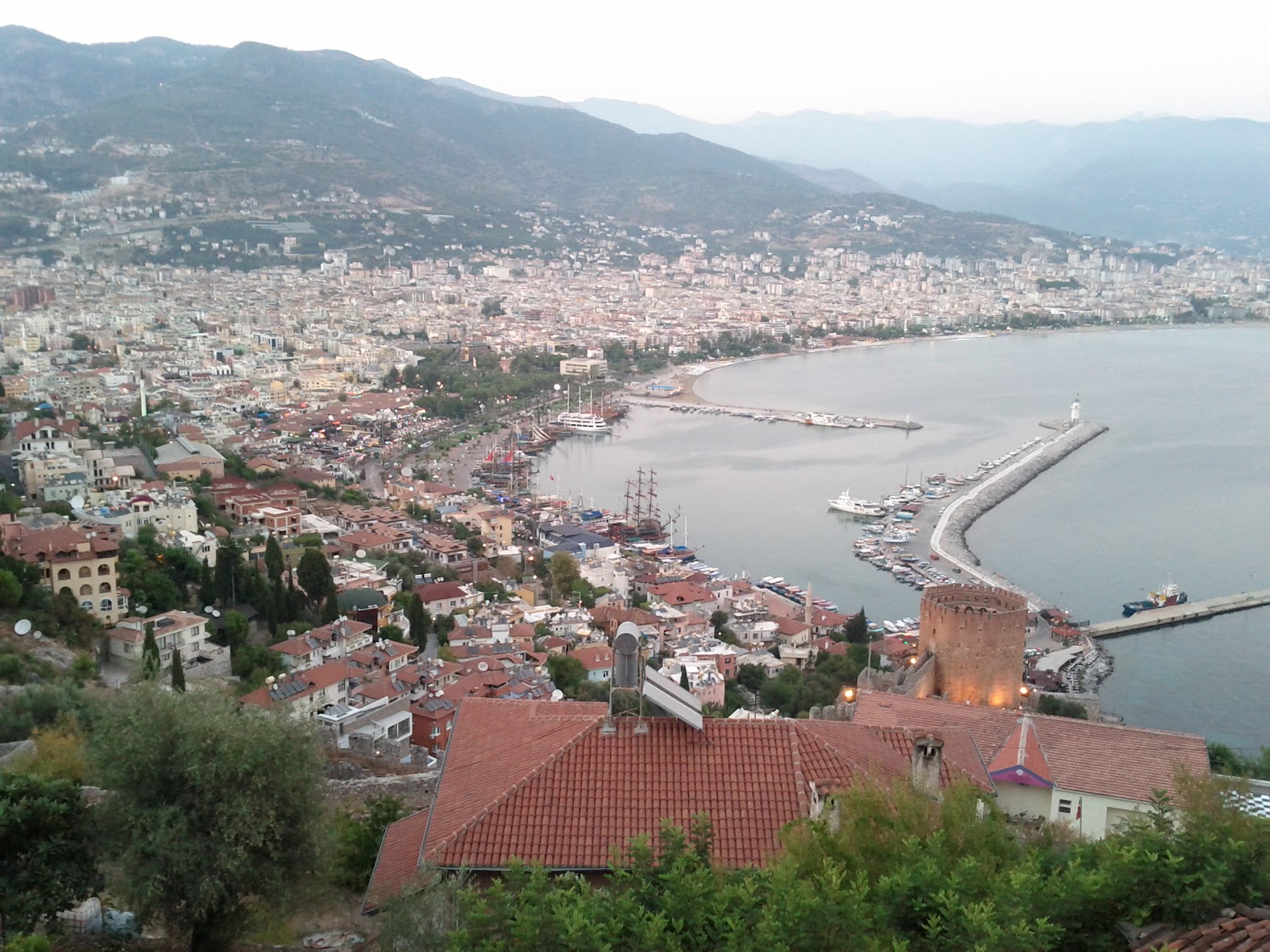
* * * Around dusk that evening we take a taxi to the cliffs above the city, up to the walls of a castle that have towered over the Alanya's bay since some time in the 12th Century.
Ola clicks a photo of the harbor below us, the neon lights of the discos just now blinking into visibility.
"You know, this type of tourism kind of depresses me," Ola says. "Because the thing is, this is a very beautiful place."
He's right: Alanya still is a beautiful place, despite all attempts to scrub it of its Turkishness and turn it into some kind of hedonistic amusement park.
Up here on the cliffs above the city, you can almost forget that somewhere below there is a miniature golf course with a hole that requires you to putt your ball through the nostrils of a Norse god.
In the harbor I can see a line of tourists disembarking from a large black bus, walking across the concrete quay straight up the gangplank of a waiting party ship. They haven't cranked up the speakers on the boat yet, at least not to the level where I can hear it on the cliffs 2,000 feet above.
But hey, the night is still young.
"It is something, though," Ola says as he snaps another photo.
Again, I agree with Ola. It is something, that's for sure.


 A flat rock sits in front the of the mouth of the cave, overlooking the valley below, like a giant bean bag chair in front of the biggest of big screen TVs. In the ceiling of the cave is an opening to another level, with more tunnels between more rooms like Habitrails for your pet hamster.
 But if you want to go ballooning in Cappadocia, there is exactly one time slot available: sometime before dawn. I'm told this has to do with the lack of wind, but I'm not buying it. I think the Turks just secretly enjoy torturing tourists by getting them out of bed before the chickens wake up.

 The sea, in fact, is miles away. Didim itself is inland, consisting of long, flat, treeless, shadeless, desolate stretches of land and an endless number of cookie-cutter, concrete apartment/condo developments. Many developments sit half finished, investors apparently taking their money and moving it somewhere less depressing. Abandoned complexes are spread throughout town, separated by empty, weed-filled lots.

 Day Five of the Cappadocia Farewell tour. Winter has returned and the day is grey, snowy and cold. I decide this is as good a time as any to check out some of Cappadocia's 36 famed underground cities. If nothing else, I reason, the Underground People knew how to get out of the wind.
 After my second underground city in Derinkuyu I've decided that I pretty much get the idea: people lived underground, and crawled through a lot of tunnels. My back hurts from bending and stooping. Here's one place I have discovered where being a tiny Asian woman has a distinct advantage over being a tall middle aged white guy.
  The lightbulb goes off. Adem and Havva. Adam and Eve. Got it.