Monday, March 26, 2012

Lost and Found

"It's very simple," Kemal the rental car man tells me as he points to the map.  "You exit the old city here, and turn to the right.  Then you go left here.  After this, you go to the second stop light - not the first, but the second - and go left again.  Then at the next stop light, you turn right, and you are on the main road out of the city."

I'm certain Kemal sees me frown and bite my lower lip as I try to memorize and count the number of turns.  He tries to reassure me.  "You can't get lost," he promises.  "It's very easy. Çok kolay."

"Çok kolay," I repeat, as if by saying the phrase out loud I can convince myself of its truth.  I've never driven in Turkey before, but the principles are all the same, right?  Right, left, two lights, another left, then a right.  Directions an imbecile could follow.

Yet even while I'm saying it, I know deep down that Kemal is mistaken.  Literally and figuratively, I've been down this road before.  It won't be easy, and I will get lost.  But one way or another, eventually, I will probably figure it out.  

Story of my life.

Emboldened by the belief that things will work out because they usually do, I open the door of my tiny Chevy Aveo rental clown car, move the seat back as far as it will go, and drive off slowly down the cobblestone streets of Antalya.

*     *     *

I had come to Antalya for two reasons.   First of all, I was tired of being cold.   Istanbul had been experiencing a colder-than-usual winter, with snow, slush, icy wind and all the other unpleasantries of a typical winter in New York or Pittsburgh.  By early March everyone is sick of it, myself included.   I wanted to go somewhere that I didn't have walk around with my collar turned up and my hands jammed in my pockets.  

Second, I had come to realize that Turkey was a big place, and in five months' time I had seen exactly one city in the entire country.   I had become like one of those foreign tourists who come to New York for three days, ride to the top of the Empire State Building, and think they've seen America.   Searching for warmth and another part of Turkey, I decided it was time to hit the road.

After thumbing through a few guidebooks and checking out a couple of internet sites, I picked Antalya: once a small fishing village and now a city of more than 1 million on the southern coast of Turkey.  Make no mistake: Antalya has been discovered.  But I am able to snag a flight from Istanbul to Antalya that cost all of $72 USD.  

That's $72, as in $72 round trip.   At this price, I could almost afford to fly back and forth every day. 

On the internet I locate a hotel that had been converted from an 18th Century Ottoman stone and timber house.  The cost of my room?  Fifty five dollars a night.   In New York or San Francisco, you might be able to find a hotel room for $55.  But that would be $55 per hour, and both you and the hooker would be afraid to sit on the bed spread.

As I board the airport bus in Istanbul to fly off to the southern coast of Turkey, the weather is gray, rainy and cold.   In contrast, as I step out of the Antalya airport on the southern coast of Turkey, the weather is gray, rainy, and somewhat less cold.  Apparently it's still winter, even in Antalya.

I see.  Maybe this is why you can still fly here for the price of a bus ticket.

*     *     *     *

Back in the rental car, I've managed to get lost in less than five minutes.  This may be a record, even for me.  After a right and two lefts, there seems to be no road on which to turn right again.  Instead, I am on an unidentified four-lane boulevard with signs pointing to some location I've never heard of.   Slowing down to try to read Turkish street signs seems to aggravate the drivers behind me, honking as if they are incredulous to have the bad luck to be stuck behind yet another clueless tourist.

I have no idea where it is I am currently headed.  But I do know that where ever it is, that's not where I want to go.   Looking on the bright side, I am beginning to narrow things down:  I need to go any direction but this.  I need to go left.  Or perhaps right.   Based on nothing but instinct, I opt for the U-Turn.

*     *     *    *

After arriving at the airport the first day, by the time I reach my little hotel in Antalya's old city (Kaleiçi, or "Inside the Castle"), it is nearly six o'clock.  My room's  sleeping arrangements consist of two twin beds, more or less pushed together.  The decor looks like something my grandmother might have picked out, if my grandmother had been a French prostitute in the 18th Century.

Still, I'm very pleased with my $55 a night accommodations.  No, it's not the Ritz Carlton, but it's not the Motel 6, either.  Outside it is still raining, and the forecast calls for more rain tomorrow.  Perhaps the less than ideal weather explains the cheap hotel rates, and the fact that I currently seem to be one of only a dozen tourists in all of Antalya.

Around 7:00 I stumble out into the rain to forage for food. I make the mistake of by passing the very chic-looking restaurant attached to the hotel, and instead wander into town to a place billed on the outside as a "kafe bistro." On the back wall inside is a flat-panel TV, with a continuous recording running of a wood-burning fireplace.   A television station in Pittsburgh used to run the same thing for six hours every Christmas morning: "The Yule Log: A Holiday Tradition!"  Hey, that's reason enough for me to give this place my business. 
 
In front of the simulated fire are two musicians, playing the bağlama and guitar.  They are not playing them particularly well.  And like the faux fireplace, the food that arrives at the table is not so much food, as it is an approximation of food.  It's as if the chef had no real experience preparing food, but had once seen pictures and tried his best to re-create it from memory.   

On a positive note, beer is served.

Hoping for better luck tomorrow,  I finish my beer and my ersatz food, warm my hands in front of the ersatz fire, zip up my anorak, and head out in the rain back to my tastefully decorated brothel.

The rain has more or less stopped the next day, but the weather remains gray, cloudy and cold.  I decide to start the day by walking through the streets of the old town.  The old town streets are indeed ancient and quaint.  They are also packed with tourist trinket shops of every conceivable incarnation. 

Unfortunately, at this stage of the season there appear to be more tourist trinket shops in Antalya than there are actual tourists.  As I walk down the street, it is as if someone has pushed the tourist alarm button and placed all shop owners on Def Con 3.  The charming cobblestone streets soon become a nightmarish gauntlet of desperate merchants, working me as if their child's next meal depends on it. 

 I imagine this is what the zombie apocalypse will be like, if the zombies are hawking rugs, T shirts, and cheap ceramics.

In response to every request to come inside and look around, I repeat again and again what soon become the five most important words in the Turkish language:  Şimdi değil, ama belki sonra. ("Not now, but maybe later.")  I repeat it so often it becomes a mantra: "Şimdi değil, ama belki sonra." "Şimdi değil, ama belki sonra."  

The magic words appease almost everyone, save for one persistent shop owner, who comes out of his doorway and begins to follow me down the street.  "Şimdi değil, ama belki sonra," I say to him. "Şimdi değil, ama belki sonra."   But he keeps coming; the words bounce off of him like bullets off the chest of Superman.  I begin to wonder if the only way to stop him is to drive a stake through his heart.

As I'm still walking, he makes one last desperate attempt to make a sale.  "I need your money!" he shouts at me in English.

I answer him over my shoulder without breaking stride. "Bende," I tell him.  Yeah. Me too.  

*     *     *    * 

As I left the shop of Kemal the rental car man, he made the following statement: "The petrol is on reserve, so you will return it on reserve."  I had no idea in hell what he was talking about.  Yet, because he was speaking English, and English is supposed to be a language I have mastered, I nodded as if I understood completely.  Yes, of course; the petrol is on reserve.  Please, Kemal, my friend.  This goes without staying.

After driving around in circles in the streets of Antalya for 15 minutes fruitlessly searching for the Road out of Town and finally glancing at the dashboard, the meaning of Kemal's words finally become clear to me.   "The petrol is on reserve," is Turkish (translated into English) for "The gas tank is empty."  Oh. I see. I probably should have clarified that, before I'd gotten lost.  

To avoid having to figure out how to say "Is there a Turkish AAA?" or "Help me; I am screwed" in Turkish, I temporarily suspend my quest for the apparently mythical Road out of Town, and start looking for something that resembles a gas station.


*     *     *     *


I emerge from the Labyrinth of the Trinket Sellers shaken, but thankfully with money still in my wallet.  With the weather still gray and overcast, I decide this might be a good time to head off to the Antalya Archaeological Museum.

Just as there aren't any tourists in the trinket shops, there aren't many history nerds in the archaeological museum either.  Perhaps there is a limited audience for Roman statues, Greek coins, and clay pots fished out of the sea, even on the worst of days.

I confess that my eyes glaze over and my mind begins to wander after about the sixth statue gallery.  I notice that on each of the seemingly dozens of statutes of Hercules, the genitalia has been completely snapped off.  Every single one.  I wonder if there was some period of male statue genitalia debasement not covered in my 9th grade history book, or if there is a separate exhibit of the offending appendages, back behind a curtain somewhere.  Surely they were not just tossed in the trash; someone must have them.   I'm not finding an explanation on any of the placards. How would I ask that in Turkish?

My God, I hope the weather is better tomorrow.

Sure enough, the skies clear and the sun comes out on the third day.   The scenery that has been obscured to this point finally shows itself.   Across an expanse of almost turquoise blue water you can see the long stretch of Mediterranean beaches, framed by a towering range of snow-capped mountains.   It's like looking at Hawaii, with Montana sticking out of it.

I rent a bike and ride out along the cliffs above the sea, running unexpectedly into the Dunden Waterfalls about 10 kilometers (6.2 miles) outside of town.  Busloads of French and German tourists have been disgorged here take photographs, but the falls are pretty spectacular all the same.


The day is topped off with a dinner at a restaurant in the Old City yacht harbor of fish soup, calamari salad, grilled sea bass, and (of course) plenty of rakı.   The only other people in the restaurant the entire time I am here is a Turkish couple entertaining an overweight Finnish businessman, who spends the evening recounting to his hosts in a loud voice how he built his business from the ground up.  At one point he summons the restaurant owner to the table, to expound on his views (in English) of proper kitchen hygiene practices.

  It is somehow comforting to know that America is not the world's sole exporter of pompous blowhards.  I order another rakı, and call it a good day.

*     *     *     *

Back in California, my sister has a GPS device in her Prius that she affectionately refers to as "Navigation Lady."   Navigation Lady is a stern dominatrix, whom my sister disobeys at her own peril ("Navigation Lady wants me to take the freeway."  "Navigation Lady is upset because I missed the turn.").  The advantage to a GPS guidance system like Navigation Lady is that you never have to really figure anything out, because you always have someone telling you what to do.   There's no denying the comfort in that.


But there is also a downside to obediently listening to what others tell you to do.   Recently in Australia a car full of Japanese tourists drove their rented Hyundai 50 yards into the ocean when the Japanese version of Navigation Lady directed them down a road that, unfortunately, didn't actually exist. 

"It told us we could drive down there," Yuzu Noda, 21, told the local Australian newspaper. "It kept saying it would navigate us to a road."  Yes, Yuzu and his friends did exactly what they were told.  You see where that got them.

There is no Navigation Lady - American, Turkish, Japanese or otherwise - in my Aveo clown car.  Yes, it's true: I am lost. But I've come by it honestly.  Eventually I will find the right road on my own.   And I'm reasonably confident that, in the process, I can avoid driving off into the ocean.

*     *     *     *


The morning after the Night of the Bloviating Finn, I head out to the the beach in Antalya. Finally, the weather is perfect: sunny, warm (68-70 degrees), and beautiful. I wade into the water and read a book on the pebbly beach.  The only other people within 100 yards of me are two young female tourists, who squeal and curse in German as they try swimming in the still-too-chilly water.  
The snow-capped mountains of the Toros Dağları rise up behind me; the blue water of the Mediterranean stretches out ahead of me all the way to Israel.   I could sit in this spot all day, or forever maybe.  It is sunny and warm and calm and comfortable.  No person in his right mind could possibly complain, or want anything more than this.

And yet.

I keep looking back over my shoulder at the mountains where I've never been before.  I throw one of the round beach stones into the water, then another.  Then I stand up and collect my things.  I remember passing a rental car place on the way down to the beach.   Kemal's something or other.

*     *     *     *

I have finally found a gas station,  and secured "petrol for the reserve."  Lost still, yes, but disaster has been averted.  In Turkish, I tell the gas station attendant (who is actually pumping my gas and cleaning my windshield, by the way) that I am looking for the Road out of Town, and ask him if he knows where I could find it. 

"Tabii,"  he tells me.  Of course.   He points to a street sign about 25 yards away, and tells me in Turkish to turn right at this sign, and go straight.   I look to where he is pointing. Turn right there? I ask him.   Yes, right there.  The place he points to is not a major road, but instead a broken-asphalt side street that appears to be headed into one of the less-desirable neighborhoods of Antalya. 

This will take me to the Road out of Town? 
Yes.
This street here?
Yes.

I look at the man again.  He has clear blue eyes, dark curly hair and a mustache growing over both sides of his mouth, like a Turkish version of Jim Croce, or perhaps, his Turkish reincarnation.

  What he is telling me seems to defy all logic.  That can't possibly be the right road; it looks completely wrong.  And yet.  I pay for the gas, thank him, climb back in the Aveo, and take a right at the sign into the ramshackle neighborhood.

Almost immediately, I'm convinced I'm completely screwed.   The street quickly narrows into little more than a one-way alley, going from broken asphalt to no asphalt at all.  I slow the car down to a crawl trying to drive around the enormous potholes.  A stray dog and three kids playing soccer in a vacant lot stop and look up at me
as I drive by, as if I have arrived in their neighborhood from another planet. 

As wrong as it seems, I have no choice but to keep going.  The road is so narrow there is no place to turn around.  Even if I could, I would still have no idea where I was anyway.

In a sense, I created all of this uncertainty the moment I stood up from my place on the beautiful beach,  and walked through the doors of Kemal's rent-a-car shop.   Of course now there is no going back to that place on the beach.  Sometimes, like it or not, the only place you can go is to go on.

After several more minutes crawling down the alleyway, I can see cars whizzing by up ahead.   It is a highway, and at the intersection I can see a sign for the airport.   It is, in fact, the Road Out of Town.

I put the Aveo in first and ease my way into the stream of traffic, heading off toward the snow-capped mountains in the distance.

I still don't know where I'm going.  But I'm on my way.

Jim Croce and Paul Simon be praised.


Thursday, March 15, 2012

Kafe Life

I always wondered who these people were I saw sitting in cafes all day long. Now I have become one of them.

We are generally a peaceful people, if perhaps a bit over caffeinated. We don’t ask for much: a reasonably comfortable chair, perhaps a small table, and a bathroom that doesn’t require a code to get into. Okay, we’ll grudgingly deal with the bathroom code, if it’s less than five digits. But then we’d better be getting some internet access, pal. There’s only so much uncompensated oppression we’re willing to take.

You will find Denizens of the Cafe all over the world, of course.  I have joined them here in Istanbul. We are writers, students, office-less workers, artists, dilettantes, ne’er-do-wells, poets, people watchers, book readers who have come out of the house for air, lost souls, social malcontents, and, I don't know, I guess people who just really really really can’t stop drinking coffee.

In Istanbul there are literally thousands of cafes (kafeler, in Turkish) and tea houses in which to hang out.  They range from those with fine china and linen tablecloths to those with paper cups and folding chairs.  The ones I frequent  (somewhere in between the two extremes) are all off the main streets of Beyoğlu.   With only one exception these are all places I just stumbled into while wandering around the back streets of my neighborhood.  I kept coming back if they offered an internet connection, and were reasonably tolerant of my mangled Turkish. 

Honestly I'd be hard pressed to give you directions to any of these places.  But if you were looking to track me down on any given afternoon, here's where you might find me.

Cafe Urban

I will confess up front that the reason I discovered Cafe Urban is because it is a cafe with a fully stocked bar, one that includes Jameson, Glenlivet, and my Turkish beer of choice, Efes Dark.  Cafe Urban also has a decent menu, where you can find everything from baked salmon to spaghetti bolognese.  

But I don't consider Cafe Urban either a bar, or a restaurant (although you could argue it is both). It is a cafe in more than name only, because it is open almost all the time, and no one cares if you sit there all day and night, as long you occasionally order something.   It can be coffee, tea, carrot cake or a double scotch on the rocks.

In this sense, Cafe Urban satisfies a large number of my necessities of life.  If they did my laundry and let me take a shower occasionally, I might never leave.


There is a slightly hip but thankfully unpretentious vibe to Cafe Urban.  It lies in a back alley-like street between Istiklal Ceddesi and the "world famous" Galatasaray Tarihi Hamami (to steal a line from Mel Brooks, it's World Famous in Turkey). The cafe itself has 4 different levels, and seems to have been built into the walls of an old bakery; the lowest level contains bricked-in ovens and vaulted stone arches from another incarnation. On the ancient stone wall hangs a large black and white photo of Times Square.

 To complete the cafe's cosmopolitan bona fides, behind another stone wall there is a single unisex restroom.  (No Starbucks code to punch in here.) Yes, you get your own locked and sealed stall, but if want to wash your hands, we're all in this together, sister.  You can go hide in the powder room some place else.

There is no doubt that ex pats from around the world have discovered this place.  On this particular afternoon I am sitting two tables down from an American guy (I heard him answer his cell phone) reading J.M. Coetzee, and a level up from a middle aged schoolteacher in a bright-red hooded sweatshirt emblazoned with the words Alman Lisesi (The German School), typing on his iPad.

But Cafe Urban still belongs to the Istanbulu, which is why I like it.  Turkish people come here any time of the day to meet and talk with their friends, or have a drink with their date after a movie.   It's one of those rare places that is as fancy or casual as you want it to be. It tries to be all things to all people, and largely succeeds. 

In other words, this the kind of place that should be in every neighborhood in the world, but isn't.  I'm happy to have it while I can.


Laterne Cafe

In my mind, the Laterne Cafe is the anti-Starbucks of the Cafe World.  I'm not sure I've seen anything like in America or anywhere else.

Yes, the Laterne is a cafe, in the sense that you can get coffee and tea, and a couple plates of food if you are hungry.   Everything here is dirt-cheap.  I have no idea how they make any money. A glass of tea cost 1.5 Turkish lira, or about 80 cents.  If you want to spring for a cappuccino (not a great cappuccino, but still), it'll set you back all of  3 lira ($1.60).   There is no menu.  The food offered - dishes of pasta salad, couscous, stuffed grape leaves, and other cold mezze - seem as if they have been prepared at the employees' homes for a company pot-luck picnic.  These saran-wrap covered dishes sit atop a small counter in the front.  If something looks good, you just point and they'll dish it out for you.

The tables are laminated white or covered with a green velour tablecloth.  The seating in the center of the room consists of two rows of wooden park-like benches, facing each other over little glass tables.  The main room (there is an upstairs, too) is usually noisy; the lighting has the florescent glow of a junior high school cafeteria. 

But the appeal of Laterne is neither the food, the cheap drinks, nor the atmosphere.   Laterne is almost always packed, almost exclusively by Turks under 25 or so.  (Apparently I'm allowed in under some kind of middle-aged foreigner novelty exception).  No, people apparently come here for another reason.  Oddly enough, they seem to actually want to talk to each other.

There is a compound verb in Turkish: sohbet etmek.  There's not really a great English translation, possibly because it's not something we do a lot of.  It essentially means to chat with, or to visit with, or spend some time with.  This is what they do at Laterne Cafe; they come here to sohbet etmek.

No one is texting or typing on their laptop (except for me, which immediately identifies me as The Freak From Another Other Country).  Instead, they chat with their friends, play tavula (backgammon), Trivial Pursuit and Scrabble (that's Turkish Scrabble, mind you, which I imagine must be something like Chinese arithmetic), and laugh and talk and just hang out.

I can't be positive, but I think the word is "socialize."  It's been so long since I've seen anything like this in America, I feel like I am trying to explain the bizarre customs of some newly discovered tribe in the Amazon.

Compare this scene to your last trip to an American Starbucks.  Look for the people who have been sitting there for hours with their ear buds in and their laptops on.   Try talking to them.  No, wait; try just making eye contact.  Odds are great they will either: a) try to ignore you, b) reach for the pepper spray, or c) contact management to have you forcefully removed from the premises.  If you want to "socialize," freak, you'd better grab a computer and get yourself to a chat room.

They like me at Laterne Cafe, even if I don't play backgammon.  When leaving I always get a smile, a handshake, and heart-felt "Görüşürüz," Turkish for "I'll see you," or literally "You will be seen." They know me too well.

 I think they figure that, sooner or later, I will cave and try the homemade potato salad.  Then there will be no turning back.

Cafe Mitanni

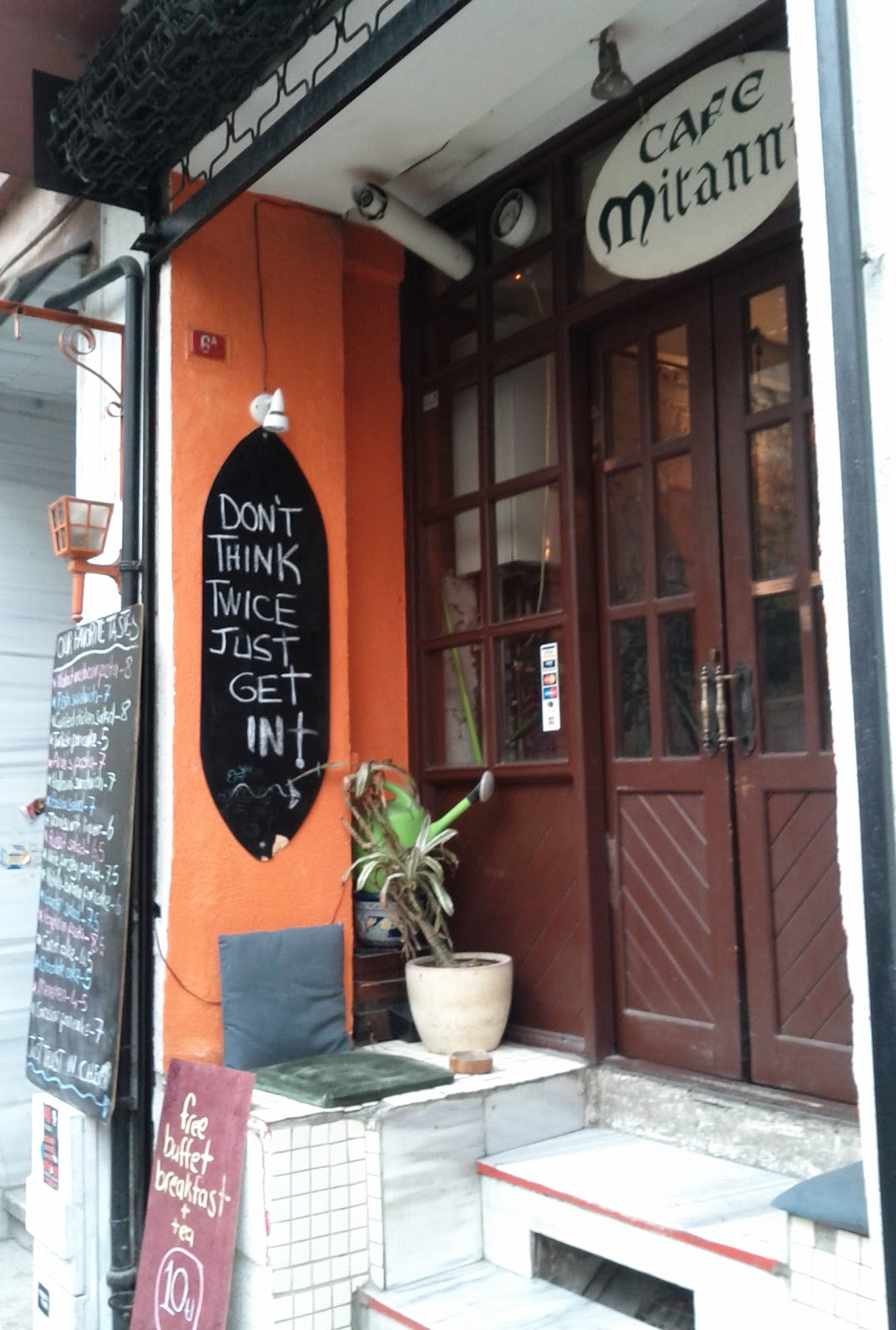
Like Cafe Laterne, Cafe Mitanni sits on a quiet back street not far from the insane crowds of Taksim Square and Istiklal Ceddese.   It's the kind of place you could never find if you were actually looking for it.  You would either have to accidentally stumble across it, or, like me, pass it a dozen times before realizing it was a semi-legitimate business.

The Cafe Mitanni menu, such as it is, is written on a chalkboard outside the entrance.  Written on a second chalkboard is a message that reads, in English, "Don't Think Twice; Just Get In!"  This leads me to believe that more than one person has stood outside the entrance, thinking twice or three times, before daring to venture inside.   

The front of the cafe is only about ten feet wide, with three small tables and folding chairs, an old radio, a magazine rack, several unwatered dying plants, and two armchairs that look like they were tossed in a dumpster after being unsuccessfully offered at a garage sale.  Sometimes the cafe is quiet; other times a particularly pensive form of jazz from the 1950s is playing, the kind you would applaud by snapping your fingers. 
Seldom is anyone sitting in the front room.  If you sit there long enough, absolutely no one will come to take your order.   You walk through a short hallway to reach the back room, where you can make your food or beverage request.  The back room is slightly larger, complete with more tables, a small couch, and an upright piano.

I will admit that the only reason I ever ventured into Cafe Mitanni was because the nearby Cafe Laterne was too crowded or noisy. I've never encountered this problem at Cafe Mitanni.


 On weekends and some evenings, instruments are set up in the corner, as if a band is getting ready to play a set.   Yet in my half dozen visits, I've yet to see any musicians actually playing anything.  I don't know; maybe it's me.  In my paranoid fantasies I imagine they are waiting for me to leave before starting, lest the music be contaminated in the front room by my tragic unhipness.

On a recent rainy Sunday afternoon, a small scruffy group of ex pats of undetermined origin in their late 20s/early 30s - complete with a golden retriever puppy wearing a bandanna - sit around the coffee table in the back room, drinking tea and eating plates of various food from a makeshift buffet, set up on a card table.   To order a cup of tea I locate the sole attendant, a shaggy haired man wearing a turquoise T-shirt and apricot-colored pants, washing dishes in a small room behind a curtain.  After about 10 minutes he brings me my tea in cup that also looks like is was thrown out after the same garage sale.  A tiny spoon is sitting almost entirely submerged in the tea, so that I burn my fingers trying to fish it out.

 My sole companion in the front room this day is a young woman wearing an overcoat and fingerless wool gloves, reading xeroxed pages of something and underlining significant passages with a tiny golf pencil.   Her backpack and tennis shoes tell me without asking that she is American.    When owner brings her a refill on her tea, I politely offer her the sugar bowl.

"No thanks," she replies in perfect California English.  "I don't do sugar." 

She doesn't do sugar.  For a moment I imagine that I have been transported back to San Francisco, and next she will tell me my meridians are out of alignment.  But no, we're still here in Istanbul, although perhaps in a bit of a time/cultural vortex.  While I don't want to hang out here every day, there is an odd comfort of home feeling that I can occasionally appreciate.

Şimdi Cafe

In contrast to Mitanni, Şimdi Cafe is the kind of place that probably belongs in Paris or Milan, rather than on a side street in the middle of Istanbul.   If beamed Star Trek-style from your living room to the middle of this cafe, I assure you your first "where am I?" guess would not be Turkey.

The waiters are all male, all wearing the same white dress shirt (yes, untucked, but still) and black pants uniform.   There is real cappuccino here, and a real wine list.   The uber-cool background music ranges from Sade to the Cure to Tom Waits.   You can order pizza or pasta, eggs or omelettes, fish soup or smoked salmon. But no Turkish lamb kabob or shepherd's salad here at Şimdi.  You will need to walk around the corner if you want that kind of action.   Even the ubiquitous glass cups of Turkish tea seen everywhere else in the city seemed to be served here reluctantly.  

Şimdi is located just a few blocks from the British, Dutch, Italian, and Swedish consulates, which may at least partially explain the international vibe.   Not many tourists have discovered Şimdi (thank God), but the ex pats of Istanbul seem to know all about it.   Let's face it; no matter how much you love Turkish tea and baklava, sometimes your body simply demands an omelet and a decent cup of coffee.

 And yes, there is liquor license.  The Efes Dark beer is served in a frosted glass, and comes with a bowl of potato chips.  All of which is great, but honestly, to steal another movie line (this one from Jerry McGuire), they had me at beer.

The hip international bon vivant vibe is not lost on the Turks, either.  They're all over Şimdi, too, for much the same reason the yabanciler (foreigners) are.   It's just a very cool place to be, no matter where you are from.
    
In front of the cafe is a communal table that seats eight, along with a couch and several green velvet chairs around a square coffee table, complete with a bowl of oranges.  (I've never been able to figure out if the oranges are meant to be food or only table decoration.  For this reason, I've never had the guts to eat one.) 

For me, Şimdi is another great place to hang out, albeit at a slightly higher cover charge than others in the rotation.  Again, as long as you are ordering something, no one is going to hurry you along.  If you sit there long enough, you can segue from your late morning tea to your afternoon coffee to your evening frosty-mugged beer without ever surrendering your seat on the couch.  Trust me; I've done it.

All this, and a bowl of chips.   Like the other Denizens of the Cafe, you know I'll be back.   As long as there's coffee and an accessible bathroom, we'll always be back.

In other words, I will be seen. 

Görüşürüz.


Saturday, February 11, 2012

The Super What?

Let me make the disclaimer up front; this is a blog about nothing.

This is a story about how I almost watched the Super Bowl in Istanbul early Monday morning.  About how I almost had a dozen amusing anecdotes about a stranger in a strange land, watching a strange game at a strange time with strange people doing strange things.   It was to be a story about love, deception, greed, lust, unbridled enthusiasm, and possibly the high stakes game of world diplomacy and international intrigue.

This would be a story with something for everyone, dripping with irony and dried off with a fluffy towel of brilliant cross-cultural insight.  A puckish satire of contemporary mores, aimed more at the heart than at the head.

To quote the great American philosopher and 1960s fictional television character Maxwell Smart ...


Look, I'll be honest.  Normally I am a pretty big sports fan.  But this year I didn't really care who would win the Super Bowl.  I wasn't really that interested in watching the game.  I had been completely out of touch with any American sports since October. For the first time in my life I had to double check to figure out which teams were actually playing. 

But as you know, the Super Bowl is not really a football game any more.  For better and for worse, it has become America's biggest cultural touchstone.  If the numbers are to be believed, more than one-third of everyone in the country watches it.  People in America who don't watch the Super Bowl have to really, really work at it,  either by running out into the middle of a dark forest somewhere, or by desperately surfing the cable channels to locate The Puppy Bowl on Animal Planet or a Who's the Boss? marathon. 

Think about the diabolical brilliance of this.  You start with football, roping in about 90 percent of American men (and a large percentage of women) without even trying.  Roll in the hype of newly released commercials, and that pulls in another big chunk of people who otherwise care nothing about sports.  By the time you throw in Madonna for a halftime show, you now have almost every TV in the country dialed in -- including those in every gay bar in America.  Now that's marketing genius.

So even though I was 5,000 miles and numerous time zones away from the nearest football not actually shaped like a soccer ball,  I decided it was my duty as an American to watch the Super Bowl in Turkey.   Missing Christmas and Thanksgiving is one thing.  Miss Christmas, Thanksgiving and the Super Bowl and I suspect they might not let me back in the country.

Watching the Super Bowl in Istanbul, however, is not as easy as it might sound.

Let's start with the time difference.  For reasons understood only by television programmers who figured out how to get Madonna into a cheerleader costume, the Super Bowl would start Sunday evening at 6:15 p.m. EST -- just in time for everyone from Boston to Miami to eat green onion and sour cream potato-chip dip for dinner.   With a seven-hour time difference,  that meant that the game would be starting in Istanbul at 1:15, and ending about 5:00.  That's 5:00 a.m., as in 5:00 Monday morning.   

I can't remember the last time I pulled an all-nighter to watch a sporting event.  But as long as I don't have a test on it the next day, I figure I'll be fine.

The next challenge would be where to watch the Super Bowl.  The television in my little basement apartment would be useless for this purpose.  There are literally hundreds of channels on my bizarre cable system, from dozens of different countries in dozens of different languages. Music videos from Balochistan.  News programs from Bulgaria.  Prayer readings from Tehran and porn channels from Italy.  But after months of surfing through all the flotsam and jetsam of Turkish cable programming, I have been able to locate exactly one English-language channel.  It is BBC News.

Oddly enough, BBC News would not be providing live coverage of the Super Bowl this year.  Apparently it had been preempted by the European debt crisis.

Still, there are just as many bars with television sets in Istanbul as there are channels on the cable system.  And Istanbul, more than any place I've ever been to (including New York), is open pretty much 24 hours a day.  Plus, I know there are Americans living here; I've heard them in the Starbucks, impatiently demanding low-fat half-caf Frappuccinos.  Surely there would be a bar with a television, somewhere in a city of 15 million people, open at 1 a.m. on a Monday morning, showing an American football game to accommodate these people.  Right?

The most promising possible venue I can think of is a bar I'd walked by a few times called The North Shield.  The bar obviously has an English-language name, a big-screen TV over the bar, a large selection of Scotch whiskey, and lots of walnut wood paneling.  True, there is nothing here that necessarily screams "American Sports Bar."  But encouragingly, a placard in the entryway announces that The North Shield proudly serves Brooklyn Lager beer.  I can't think of anything much more American than that.

On a reconnaissance mission to The North Shield a few nights before the game, I find there is indeed a television above the bar. On this particular night, however, the programming they are offering is a snooker match, which I can't take as a particularly good sign.  I ask the bartender in Turkish if they will be showing the Super Bowl at the bar on Sunday night.   He seems confused by the question.

"The what?" he asks in Turkish.

"The Super Bowl."

"Su-per Bowl," he repeats slowly in English, as if it might make more sense if he sounds it out it phonetically. 

"Amerikalı futbolu şampiyonluk maçı," I manage to get out.

"When?" he asks again in Turkish.
"Sunday," I tell him.  "Well, early Monday morning."

He looks at me as if I'm delirious, and/or possibly confused as to how to say times of the day in Turkish. ("Monday morning?")  To my surprise, he nods his head and says, "Yes, maybe," before going back to washing glasses behind the bar. 

Still, this is not really the answer I'm looking for. Are you showing the game or aren't you?  If I'm walking out into the cold at 1:00 in the morning,  I'm going to need a little more certainty than that.  "Yes, we're stocked with Bud Light and the chicken wings have been ordered."  That kind of certainty.  So far I'm not really buying it.

Dubious about The North Shield, I decide to put a call out on one of the Istanbul ex-pat website forums, asking if anyone knows of a bar in Beyoğlu that will be showing the Super Bowl.   There is no response for a day or so.  Then finally, a fellow American identified as Jeffrey ("Istanbul/Self Employed") posts the answer I've been waiting for.

"James Joyce on Balo Sk.," Jeffrey's post reads,  "(alhtough [sic] dank n dark and beer not cold)."

Jeffrey, this is perfect.  I am going to go to an Irish bar called the James Joyce Pub, located in the heart of Turkish Istanbul, at 1:00 in the morning to watch the world's greatest display of American excess?  The potential cultural train wreck is just too wonderful to contemplate.  (Dank n dark and beer not cold? Who cares! Come on, Jeffrey.  It's an Irish bar.)


Who will be there, I wonder?  Will there be Turkish contingents of face-painted Giants and Patriot fans, taunting each other across the bar?   Will I be sitting next to an Irish ex-pat who wandered in for a shot of Jameson, only to be thrust into this early morning orgy of American sports culture?  Will I find someone to explain Ulysses or Turkish grammar to me, in exchange for a demonstration of an illegal horse collar tackle?

I drool at the possibilities.  This blog entry, I am absolutely certain, is simply going to write itself.

The streets are as empty as you might imagine they would be when I walk out my door at 1 a.m. Monday morning.  It's cold as hell, and remarkably quiet, as the throbbing non-stop techno-beat of the disco on the hill above my street probably won't be cranked up for another hour or so.  It's so late that even the neighborhood cats are asleep, or perhaps simply frozen into silence.

It's about a 15-minute walk from my apartment to the James Joyce Pub, located just off Istanbul's main pedestrian street, Istiklal Ceddesi.  This should get me there just in time for the 1:15 a.m. kickoff.  I start to think it might have been a mistake not to go earlier, to make sure I could get a place at the bar with a good view of the television.  But I rationalize that it will be better to mix among the crowd, observing the cultural irony from as many angles as possible.

Look! Is that an Irishman with a copy of The Dubliners drinking rakı through a tube out of a New York Giants beer helmet?  Wait; I think that table singing all six verses of Molly Malone is dipping Doritos into the patlican salata!  Who do I talk to first?

When I arrive at the James Joyce, through the window I can see the big-screen TV on the back wall of the bar.  The game is indeed on and about to start, as I recognize the pre-game commentators.  The screen is so large you can almost see Chris Collinsworth's nose hair from 5,000 miles away.

But as I walk into the bar, I have the sense that something is not ... quite ... right.  What is it, exactly?  I'm trying to put my finger on it ... something odd ... OK, yes, I see the problem now.

The Super Bowl broadcast at this moment is being watched by more than 100 million people all over the world.  Not a single one of those people, however, is currently located in the James Joyce Pub.

Yes, the bar is entirely empty.  It's as if a neutron bomb had been set off, vaporizing every American football fan within a 20-mile radius.  If tumbleweeds existed in Turkey, I'm sure they would have been rolling out of the men's room and across the floor at that moment.

With the sound on the big-screen television muted, there is complete silence, like I have walked into not the James Joyce Pub, but instead the James Joyce Reading Room.  I am about to say something out loud, but I'm afraid I might be shushed.

Finally a lone bartender pops up from behind the bar.  He seems startled to see me.   
"The bar is closed," he says to me in Turkish.  "Bar kapılı."

I respond by pointing at the game on the big-screen TV and stammering in bad Turkish. "But ... but ... Super Bowl ... Amerikalı futbolu şampiyonluk maçı ... televizyonda şimdi ...

"I know," the bartender cuts me off in Turkish.  "But," he gestures to the room, "there are no people.  Opportunity yok."

I believe "Opportunity yok" roughly translates as "I stayed open until one in the morning on a Sunday expecting a bunch of Americans to come and to watch their stupid little football game, you're the only one who showed up, and I'm not staying up all night to serve drinks to one single idiot sitting by himself in front of my giant television screen, so, you know, get the hell out of here."

Roughly.

Making one last desperate attempt to find irony, I walk 15 minutes farther away from home to The North Shield, hoping that the bartenders' earlier "yes, maybe we'll have the Super Bowl on" had turned into reality.   But of course the story at The North Shield is much the same.   No one is in the bar, other than a couple of guys cleaning up and stacking chairs on the table.

On the plus side, the televised snooker match has finally ended.

Opportunity yok.

Now it's almost two in the morning, I'm facing a half hour walk home, and it's so cold I already can't feel my toes.  And, oh yeah: I won't be seeing the Super Bowl, or finding any great stories about how hilarious it is to watch it in Turkey.   Other than that, this has all worked out perfectly. 

Living in America you might be shocked to learn that the world does not stop rotating on Super Sunday.  In Istanbul at least, nobody gives a crap.  At least nobody gives enough of a crap to stay up drinking in a bar in the middle of the night at the beginning of a work week.

 I turn around and walk back home in the cold.  On the way there, absolutely positively nothing happens. 

See? I tried to warn you.  But you went ahead and read this whole thing anyway.

Finally there's some irony for you.


Sunday, January 29, 2012

A trip to the baths

I don't really have an issue with the touching.

Like most Americans,  I think, I am fine being touched: hugged, embraced, massaged ... listen, I've been known to enjoy the occasional grope.  But I'm not so sure how we feel about being scrubbed.  I'm particularly not so sure how we feel about being scrubbed with woolly mitts by large men wearing loincloths.

So let me tell you about the hamam.  The hamam, or "Turkish bath" as you might know it, is a tradition that apparently goes way, way back.  Like Roman Empire back.  After the empire fell and most of Europe chose to wallow around in the mud for a few centuries, the Ottomans decided they actually preferred being clean, and for that reason the hamam was something worth keeping around.  The hamams are still around, all over Istanbul and (I'm told) the rest of Turkey as well.

But being neither a Turk, Ottoman, nor ancient Roman, I knew nothing of this.  In America, we don't have communal baths.  We're not too crazy about the showers at the Y, to be honest.  Our basic national attitude seems to be, if you insist on being naked and wet, for God's sake please do it in the privacy of your own home.

Not really a good attitude if you are headed into the hamam. 

There are dozens of hamams of all kinds in Istanbul, from the swankiest at places like the Ritz and the Four Seasons, to little back-alley hamams where they hang the towels outside the entrance on collapsible laundry racks.   I decide to choose a hamam in the same discriminating way I choose a barber or a grocery store: whatever I walk by on the way home is probably fine. (Granted, this has led to several bad haircuts and a lot of suspect produce, but we'll leave that for another entry).   The hamam on the way home to my flat in Istanbul, it turns out, is no fly-by-night bath house.  It has been there since before Columbus aimed for India, and mistakenly stumbled across the Bahamas.

You heard me.  The "Historical Galatasaray Hamam" (Tarihi Galatasaray Hamamı) was opened in -- are you ready? --  1481.  In other words, people have been soaped, lathered, and rinsed at this very spot, continuously, for 531 years. 

I can only imagine the hair clog in the drain.

The first thing you need to know about the Turkish bath is that it's not really a bath, in the sense that Americans know a bath.  There is no tub, and you are not immersed in water.  Here, let me have the fine folks at the Tarihi Galatasaray Hamamı explain.  This is taken word for word from the English language version of the hamam's promotional pamphlet:

Hamam User's Guide:

The visitor of Hamam is welcomed in Hamam Square.

The visitor [is] welcomed by the Yanasma (room keeper) and shown his room.

[The] yanasma gives the visitor takunya (wooden sabots-pattens) and pestemal (loincloth).


The visitor, after tying up his loincloths [sic], and wearing his pattens in his room, comes to the hamam square.

Here, the massager (keseci) meets him.

The visitor entering the hamam, lies on the heated marble platform (gobektasi), covered with a thin cloth (serme). Before taking the bath, he lies on the marble platform for minimum [of] 20 minutes, to sweat and prepare his body for kese (rubbing with a bath glove).

Later, [the] visitor is taken to the kurna (marble basin under the tap), and rubbed and given a bubble bath and later lies on the marble platform again for massage.


After the massage, a shocking shower may be taken as wished.

Our guests, with their services completed, is [sic] free from now on, he may take a shower again or lay on the marble platform to rest.

Our guest wishing to leave, takes his bathing and hair towel in the warm section and leads to hamam square.

The visitor reaches to his normal body temperature again, during his time spend [sic] in hamam square for 15-20 minutes. At this time, he relaxes [and] eith[er] the hot or cold beverages serviced [sic].

The visitor, after dressing in his room,  makes payment when leaving.

According to the level of satisfaction, a 10% tip is ethical for the staff.

In other words, you are disrobed, steamed, baked, broiled, seared, seasoned with lemon pepper (OK, I made that up), soaped, scrubbed, contorted, rinsed, soaped and scrubbed some more, thrust into a cold shower (and it is "shocking"; they aren't lying about that), wrapped in towels, and handed a glass of tea. But no bath, in the conventional sense.  Despite the "bubble bath" reference, I assure you Mr. Bubble plays absolutely no part in the ritual.


The interior decor of the Galatasaray Hamam itself is a bit of time-machine whiplash. The inner rooms of the hamam may have changed little since it opened in the late 15th Century. The main outer room, however, was for some unknown reason "remodeled" in the mid 1960s, when they apparently installed laminated faux-wood dressing rooms, a white-railing spiral staircase, and snack bar. The contrast between the two areas is something like entering the Aya Sofia after stepping directly off the set of "My Three Sons" or "The Lucy Show."

But, as promised in the brochure, upon arrival I am given slippers and led up the spiral staircase to my little laminated wood dressing room, that includes a narrow cot-like bed for any post-scrubbing nap I might want to take.  And yet when I see this, the words that come to my mind are not "mmm, nap," but rather "yikes, hospital psych ward."  To sleep here, I'd have to be really tired.  Or heavily sedated.

My clothes are off, and I've done my best at "tying up my loincloths."  But emerging from my dressing room I see that tucking it in on the side like a bath towel clearly is not going to work, as it is impossible to walk five steps before the tuck comes loose.  Sadly I have to be shown by the yanasma how to tie a loincloth.  I'd be more embarrassed by this, but I am honestly not ashamed to admit that to date I have limited loincloth-tying experience.

Downstairs in the main room, slippers are now traded for wooden clogs.  I have to say, the loincloth/wooden clog combo is quite an international fashion statement.  I suspect I look like a half-naked Little Dutch Boy, off to put his finger in the dyke somewhere in French Polynesia.

Walking through the Douglas' family living room past Ernie and Chip and Uncle Charley (oh, I'm kidding; it was just a couple of guys at the snack bar),  I am greeted by the keseci, also wearing clogs and a loincloth, but with an enormous belly to hold it up.  He leads me into the inner part of the hamam known as "the hot room."  The name is self-explanatory.  Everything is marble, and everything is really, really hot (hence the need for wooden clogs to walk on the hot marble floor).  The keseci puts a thin sheet and a little pillow on a big marble slab, and leaves the room.  Like an obedient and reasonably intelligent Labrador retriever, I figure out this probably is the command to "lie down." I do as I'm told.

I admit, lying on my back on the hot marble slab is kind of nice, at first.  The room has a high-ceilinged dome, with 531-year-old star-shaped skylights.  Water is dripping somewhere, and there is an echo in the room.  I can begin to see why people would find this relaxing, even meditative.

But after a few minutes, I realize that I am repeatedly lifting my back and shoulder blades off the slab, because holy crap this marble is hot! The sweat glands have been called into action, and within minutes I'm completely drenched.  Thanks to the hamam, I finally understand what it must feel like to try to take a midday nap on the steps of the Lincoln Memorial, in the middle of August.

I don't have a watch on, obviously, but it seems like I've been lying here more than 20 minutes.  What happened to the fat man in the loincloth?  Have they forgotten about me?  Am I supposed to signal somehow that I am sufficiently broiled? Should I flip myself over so that I will be evenly cooked?  How many times in the past 531 years has someone accidentally roasted to death in the hot room?

Finally, the large loin-clothed man does return.  He appears to be carrying a bucket and a sponge mitt, like he's headed from the garage out to the driveway on a Sunday afternoon to wash the Nissan Sentra.

This can't be good.

Before I tell you about the actual scrubbing, let me just pause here for a moment to comment on the veracity of  Turkish bath promotional pamphlets.  The Tarihi Galatasaray Hamamı pamphlet has numerous photos of beautiful, half-naked men and women together in the hamam, pouring water on each other, drinking wine and feeding each other grapes, as if an orgy is just about to break out, or has just recently concluded. 

Based on my admittedly limited experience, I suspect these photos might be a little misleading.  To begin with, men and woman do not bathe together in the hamam, and they haven't for, oh I don't know, a good 531 years? (A separate hamam for women, with a completely separate entrance, is located on the other side of the building).   Second, in one photo the models appear to be drinking hot coffee in the 4,000-degree hot room, meaning that they are either: a) insane; b) suicidal, or c) greased up and posing in front of a fake hamam background, in an air-conditioned photographer's studio somewhere in South America.

I can assure you, there are no models in the hot room.  Nor do they offer wine, grapes, coffee, or erotic sexual encounters.  Instead, the experience is more realistically depicted like this:


I really don't know the last time I was actually scrubbed.  Perhaps at the age of 5, but if so, up to now I have been able to successfully repress the memory.  Whenever it was, I'm pretty sure it was not done by a 300-pound man wearing a checkered tablecloth.  That I would have remembered.

The brochure tells you that the purpose of being soaped up and rubbed down with a woolen "bath glove" is to remove the dead skin.  I have no doubt this is correct.  Of course it also removes the live skin as well, but let's not quibble about collateral damage.  If this is a war against dirt, then this is the bathing version of shock and awe.  Stuff happens.

Once I am fully soaped and scrubbed, the keseci then begins to lean on me, pressing and pushing and pulling and contorting my limbs.  I am assuming this is the "message" portion of the program.  My shoulder may have been separated during the process, but I decide to ignore it.  Honestly I am just happy to be keeping my loincloth on.

Eventually as promised I am "taken to the kurna (marble basin under the tap)," and rinsed off like the loyal Labrador I have become.  Fortunately this is done with bowls of warm water, and not the garden hose.  More soaping is done, more scrubbing, then more rinsing.  You just can't get clean enough at the hamam, apparently.

Soaped and scrubbed and rinsed and soaped and rinsed again, I put my clogs back on and move from the hot room to the "warm room."  Which would be great, except that the "warm room" also contains the "shocking" cold shower mentioned in the brochure.  So on balance, it's not really a "warm room" at all, is it?   I guess "potential heart attack room," while certainly more accurate, probably was rejected by the guys down in marketing.

After being sufficiently shocked in the shower, I am wrapped in towels, including one that goes over my head and behind the ears, Egyptian pharaoh style.  I am then led back into the remodeled exterior room ("Hamam Square"), where I'm half-expecting Eva Gabor to show up in a white pantsuit to serve drinks.  Sadly, it's only the yanasma.  No hots cakes, but he does have my slippers and the keys to my nap room. 

I understand the appeal of the hamam, and really, I'm in no position to knock a practice that has outlasted a couple of empires.  As individual concepts, I have nothing against sweat, saunas, slippers, clogs, ancient Egyptian after-bath head wear, or large Turkish men with bath mitts and buckets of soap. 

But I think I'll stick with Do-It-Yourself bathing, thanks.  True, I may not be quite as clean as I could be.  But so far the self-scrub has limited the complaints of others, and for the most part, kept me out of trouble.

As an added bonus, it's also mostly kept me out of loincloths.


Saturday, January 14, 2012

Smoking apple and drinking licorice

I don't think anyone is going to accuse the average Turk of being a health nut.  True, Turks may not drink Big Gulps and eat giant bags of Oreos while driving their SUVs down to the all-you-can-eat buffet at the Cracker Barrel (I'm looking at you, America).  But they do maintain their share of vices.  I, of course, saw no reason not to take a few of those vices out for a test run. 

The strong tea and baklava (God help me, I do love it so)  I can probably survive.  Rakı and nargile, on the other hand, could take me out in short order.

For those of you who don't know - and why would you, really? - rakı (pronounced rock-ah, not rock-ee)  is the national drink of Turkey.  The books tell me rakı is distilled from grapes, mixed with ethanol, and laced with anise.  It runs about 90 proof, i.e., 45 percent pure alcohol.  In addition to serving as a beverage, I'm guessing rakı also can be used as a paint thinner, and possibly as fuel for the internal combustion engine.

Rakı is so strong, in fact, that no one just sits in a bar drinking rakı.  That would be suicide.  Instead, the Turks insist that rakı be drunk only with food, most commonly with seafood.  If you look around the tables at any Istanbul fish restaurant, you can immediately spot the tourist by finding a wine glass on a table.  All the self-respecting Turks are drinking their rakı.

Rakı is clear like vodka (or rubbing alcohol, for that matter), and served in a tall thin glass.  The hard-core rakı drinkers will take it neat; the more timid mix it with water, which for chemical reasons beyond my understanding, turns the drink a milky white.  Ice can also be added, if that's how you like your milk-colored, anise-flavored alcoholic beverage.  The French have a version of this (pastis), as do the Greeks (ouzo and sambuca) and, oddly, the Colombians (aguardiente).  The translation of the South American version - aguardiente - is literally "fiery water."  Enough said.

The first time I tried rakı, I truly hated it.  Hated it.   I never liked the taste of anise or licorice to begin with, from the first handful of Good & Plenty candy I spat out as a child.  Mix that with 90 proof alcohol, and I felt like I was choking down red rope dissolved in kerosene. Ugh.  The national drink?  Really?

Couldn't they at least try the whiskey?

But the fact is I wanted to like rakı.  Turkey is where I live now, and this is what Turkish drinkers who drink alcohol want to drink when they're out drinking (and eating fish, at least).  Who wants to sit at dinner with a group of Turks laughing and talking and toasting each other with rakı while you ask the waiter if he can perhaps recommend a nice Cabernet, precocious yet with a hint of whimsy?   It would be like going to Oktoberfest in Munich and ordering a mojito.

So I kept giving rakı its second, third, and fourth chances. With water, and three cubes of ice, please, or as we say in Turkey, buzlu. Yes, it still tasted like red rope.  But at least it was cold red rope.

Then, on about the fourth try, I noticed that the rakı started going down much easier.  After an hour or so, as the rakı glass continued to be refilled, I stopped in mid-sentence, looked across the table at my dinner companion and said:  "You know, I am really digging this rakı!  Should we get more?" 

 Just like that, the rakı makers had sucked in another convert.  Remember, it is 45 percent alcohol.  My theory is that the brain cells charged with remembering that the drink tastes like licorice are systematically eliminated, like witnesses to a mob hit.  Eventually most of the remaining brain cells decide that, hey, this actually tastes pretty good.  The others are beaten into submission, or otherwise intimidated into silence. 

Perhaps this is something the makers of Good & Plenty should look into.

Of course drinking - even drinking fiery licorice water - is one thing.  Smoking is quite another.

I smoked my last cigarette on April Fool's Day, 1986.  I was eight years old.  

Oh, I'm joking, of course.  I was twelve years old. 

In fact I was a serious smoker back in the day, but since that time I have rarely, if ever, had any kind of craving for a cigarette or any other tobacco-related product.  If I'm honest about it, I will admit that part of the reason I quit was that smoking was no longer an acceptable social activity (in contrast to, say, the much more socially acceptable activity of binge drinking).  We've done a pretty effective job of turning smokers into social pariahs, forcing them into a back room or out in the cold if they still want to light up.  If you want to smoke in America, you have to really want to smoke.

Turkey, however, hasn't made it nearly as far down this path.  True, smoking cigarettes is officially banned in all enclosed public spaces in Istanbul.  (Bars and some restaurants will wink at this, bringing a customer a paper cup for an ashtray if they pull out a cigarette).  But that ban has not been extended to the nargile bar - a centuries-old establishment that combines the conviviality of a coffee house with the ambiance of a Chinese opium den.


If you know about nargile (nar-geel-eh) at all, you probably know it as hookah, or shisha, as it is called throughout the Middle East.  It is essentially an over sized, bong-like water pipe with a hose sticking out of it.  Attached to the hose - in Turkey, at least - is perhaps a two-foot-long, baton-like stick that looks like something a snake charmer would play.  Atop the water pipe is a bowl and a metal tray.  In the bowl is placed, um, something to smoke.  The bowl is then covered with foil, and heated with coals. 

When you walk into a nargile bar, you truly know you are not in Shreveport anymore.  The clientele usually is about 90 percent men, and often you do get to sit close to the ground on little cushions, just like the inside of Barbara Eden's bottle on "I Dream of Jeannie."  (That fact alone might explain its lasting popularity.)

While I had passed by countless nargile bars in Istanbul, this was not an activity I was likely to try on my own.  I would have no idea what I was doing, and I would hate to cause an international incident by trying to suck on the wrong end of something.  Yet when my long-time friend Mark came to visit recently, it was only a matter of time before we ended up at a bar that just happened to offer nargile.  And what were going to do when offered?  Just say no?

I had never been anywhere near a nargile pipe before coming to Turkey. Quite honestly I had no idea what it was, or at least, what was being smoked.  This particular bar offered the nargile in a variety of "flavors."  As the menu was in Turkish, the only flavor I recognized was apple (elma), so that's what I picked.  The waiter appeared to be pleased with my choice, and this seemed harmless enough to me.   It was hard to imagine falling into a bad crowd by smoking something that normally comes in a pastry.


The waiter loaded up and covered the bowl, stuck on some hot coals, and fired up the pipe.  We were given our own individual little plastic mouthpieces to fit into the smoking baton.  When I held the fabric-covered stick up to mouth for the first time I felt slightly ridiculous, realizing that this is exactly what I would look like if I played the oboe. 

But the smoke went down surprisingly smoothly, as if this wasn't really smoking at all.  This, of course, is the whole idea.   It didn't quite taste like apple, but it didn't taste like tobacco, either.   Groups at each table talked and laughed, passed their pipes back and forth, and ordered more drinks.  I gave a big thumbs up to the social part of Social Smoking.   But then again, for the first time since the Nancy Reagan Administration, I was smoking.  I mean, I was smoking something

Whatever I was smoking, I rationalized that it couldn't be as bad as smoking a cigarette.  If there was any tobacco at all, I figured it must be some kind of faux tobacco, like the nicotine version of Splenda, or I Can't Believe It's Not Butter.  It was apple, for God's sake.  This was probably just like smoking a piece of pie, right?

Post-nargile bar research revealed that I was right.  Smoking nargile is not as bad as smoking a cigarette.  It's actually 100 times worse than smoking a cigarette.

The substance being smoked is in fact tobacco, claims of "apple" not withstanding.  According to the Mayo Clinic, each nargile session typically lasts more than 40 minutes (yeah, I'm sure we hit that), and consists of 50 to 200 inhalations that each range from 0.15 to 0.50 liters of smoke (sounds about right). That means that in an hour-long smoking session of nargile, a user will consume about 100 to 200 times the smoke of a single cigarette; in a 45-minute smoking session a typical smoker would inhale 1.7 times the nicotine of a single cigarette.  

Oh.  I see.  So I guess what the Mayo Clinic is trying to tell me is that as much as I'd like to pretend otherwise, smoking nargile is not just like playing the oboe. 

So alright then: for the sake of my lungs I guess I'll pass on the nargile, and stick with the tea, baklava, and occasional rakı.  If only I knew where I could snag some of those I Dream of Jeannie throw pillows.