Saturday, January 14, 2012

Smoking apple and drinking licorice

I don't think anyone is going to accuse the average Turk of being a health nut.  True, Turks may not drink Big Gulps and eat giant bags of Oreos while driving their SUVs down to the all-you-can-eat buffet at the Cracker Barrel (I'm looking at you, America).  But they do maintain their share of vices.  I, of course, saw no reason not to take a few of those vices out for a test run. 

The strong tea and baklava (God help me, I do love it so)  I can probably survive.  Rakı and nargile, on the other hand, could take me out in short order.

For those of you who don't know - and why would you, really? - rakı (pronounced rock-ah, not rock-ee)  is the national drink of Turkey.  The books tell me rakı is distilled from grapes, mixed with ethanol, and laced with anise.  It runs about 90 proof, i.e., 45 percent pure alcohol.  In addition to serving as a beverage, I'm guessing rakı also can be used as a paint thinner, and possibly as fuel for the internal combustion engine.

Rakı is so strong, in fact, that no one just sits in a bar drinking rakı.  That would be suicide.  Instead, the Turks insist that rakı be drunk only with food, most commonly with seafood.  If you look around the tables at any Istanbul fish restaurant, you can immediately spot the tourist by finding a wine glass on a table.  All the self-respecting Turks are drinking their rakı.

Rakı is clear like vodka (or rubbing alcohol, for that matter), and served in a tall thin glass.  The hard-core rakı drinkers will take it neat; the more timid mix it with water, which for chemical reasons beyond my understanding, turns the drink a milky white.  Ice can also be added, if that's how you like your milk-colored, anise-flavored alcoholic beverage.  The French have a version of this (pastis), as do the Greeks (ouzo and sambuca) and, oddly, the Colombians (aguardiente).  The translation of the South American version - aguardiente - is literally "fiery water."  Enough said.

The first time I tried rakı, I truly hated it.  Hated it.   I never liked the taste of anise or licorice to begin with, from the first handful of Good & Plenty candy I spat out as a child.  Mix that with 90 proof alcohol, and I felt like I was choking down red rope dissolved in kerosene. Ugh.  The national drink?  Really?

Couldn't they at least try the whiskey?

But the fact is I wanted to like rakı.  Turkey is where I live now, and this is what Turkish drinkers who drink alcohol want to drink when they're out drinking (and eating fish, at least).  Who wants to sit at dinner with a group of Turks laughing and talking and toasting each other with rakı while you ask the waiter if he can perhaps recommend a nice Cabernet, precocious yet with a hint of whimsy?   It would be like going to Oktoberfest in Munich and ordering a mojito.

So I kept giving rakı its second, third, and fourth chances. With water, and three cubes of ice, please, or as we say in Turkey, buzlu. Yes, it still tasted like red rope.  But at least it was cold red rope.

Then, on about the fourth try, I noticed that the rakı started going down much easier.  After an hour or so, as the rakı glass continued to be refilled, I stopped in mid-sentence, looked across the table at my dinner companion and said:  "You know, I am really digging this rakı!  Should we get more?" 

 Just like that, the rakı makers had sucked in another convert.  Remember, it is 45 percent alcohol.  My theory is that the brain cells charged with remembering that the drink tastes like licorice are systematically eliminated, like witnesses to a mob hit.  Eventually most of the remaining brain cells decide that, hey, this actually tastes pretty good.  The others are beaten into submission, or otherwise intimidated into silence. 

Perhaps this is something the makers of Good & Plenty should look into.

Of course drinking - even drinking fiery licorice water - is one thing.  Smoking is quite another.

I smoked my last cigarette on April Fool's Day, 1986.  I was eight years old.  

Oh, I'm joking, of course.  I was twelve years old. 

In fact I was a serious smoker back in the day, but since that time I have rarely, if ever, had any kind of craving for a cigarette or any other tobacco-related product.  If I'm honest about it, I will admit that part of the reason I quit was that smoking was no longer an acceptable social activity (in contrast to, say, the much more socially acceptable activity of binge drinking).  We've done a pretty effective job of turning smokers into social pariahs, forcing them into a back room or out in the cold if they still want to light up.  If you want to smoke in America, you have to really want to smoke.

Turkey, however, hasn't made it nearly as far down this path.  True, smoking cigarettes is officially banned in all enclosed public spaces in Istanbul.  (Bars and some restaurants will wink at this, bringing a customer a paper cup for an ashtray if they pull out a cigarette).  But that ban has not been extended to the nargile bar - a centuries-old establishment that combines the conviviality of a coffee house with the ambiance of a Chinese opium den.


If you know about nargile (nar-geel-eh) at all, you probably know it as hookah, or shisha, as it is called throughout the Middle East.  It is essentially an over sized, bong-like water pipe with a hose sticking out of it.  Attached to the hose - in Turkey, at least - is perhaps a two-foot-long, baton-like stick that looks like something a snake charmer would play.  Atop the water pipe is a bowl and a metal tray.  In the bowl is placed, um, something to smoke.  The bowl is then covered with foil, and heated with coals. 

When you walk into a nargile bar, you truly know you are not in Shreveport anymore.  The clientele usually is about 90 percent men, and often you do get to sit close to the ground on little cushions, just like the inside of Barbara Eden's bottle on "I Dream of Jeannie."  (That fact alone might explain its lasting popularity.)

While I had passed by countless nargile bars in Istanbul, this was not an activity I was likely to try on my own.  I would have no idea what I was doing, and I would hate to cause an international incident by trying to suck on the wrong end of something.  Yet when my long-time friend Mark came to visit recently, it was only a matter of time before we ended up at a bar that just happened to offer nargile.  And what were going to do when offered?  Just say no?

I had never been anywhere near a nargile pipe before coming to Turkey. Quite honestly I had no idea what it was, or at least, what was being smoked.  This particular bar offered the nargile in a variety of "flavors."  As the menu was in Turkish, the only flavor I recognized was apple (elma), so that's what I picked.  The waiter appeared to be pleased with my choice, and this seemed harmless enough to me.   It was hard to imagine falling into a bad crowd by smoking something that normally comes in a pastry.


The waiter loaded up and covered the bowl, stuck on some hot coals, and fired up the pipe.  We were given our own individual little plastic mouthpieces to fit into the smoking baton.  When I held the fabric-covered stick up to mouth for the first time I felt slightly ridiculous, realizing that this is exactly what I would look like if I played the oboe. 

But the smoke went down surprisingly smoothly, as if this wasn't really smoking at all.  This, of course, is the whole idea.   It didn't quite taste like apple, but it didn't taste like tobacco, either.   Groups at each table talked and laughed, passed their pipes back and forth, and ordered more drinks.  I gave a big thumbs up to the social part of Social Smoking.   But then again, for the first time since the Nancy Reagan Administration, I was smoking.  I mean, I was smoking something. 

Whatever I was smoking, I rationalized that it couldn't be as bad as smoking a cigarette.  If there was any tobacco at all, I figured it must be some kind of faux tobacco, like the nicotine version of Splenda, or I Can't Believe It's Not Butter.  It was apple, for God's sake.  This was probably just like smoking a piece of pie, right?

Post-nargile bar research revealed that I was right.  Smoking nargile is not as bad as smoking a cigarette.  It's actually 100 times worse than smoking a cigarette.

The substance being smoked is in fact tobacco, claims of "apple" not withstanding.  According to the Mayo Clinic, each nargile session typically lasts more than 40 minutes (yeah, I'm sure we hit that), and consists of 50 to 200 inhalations that each range from 0.15 to 0.50 liters of smoke (sounds about right). That means that in an hour-long smoking session of nargile, a user will consume about 100 to 200 times the smoke of a single cigarette; in a 45-minute smoking session a typical smoker would inhale 1.7 times the nicotine of a single cigarette.  

Oh.  I see.  So I guess what the Mayo Clinic is trying to tell me is that as much as I'd like to pretend otherwise, smoking nargile is not just like playing the oboe. 

So alright then: for the sake of my lungs I guess I'll pass on the nargile, and stick with the tea, baklava, and occasional rakı.  If only I knew where I could snag some of those I Dream of Jeannie throw pillows.  


Sunday, January 1, 2012

Happy New Year from the Panpan Kafe

  I have always believed there are two kinds of people in this world: those who look forward to New Years’ Eve, and those who are content to stay home and find out whether Dick Clark is still allowed to stay up past midnight.

  I myself have always loved the New Year holiday, somehow nearly always stumbling into some memorable New Years’ Eve story, then happily nursing a hangover the following day by watching an endless stream of meaningless college bowl games on TV.  (There's a Tangerine Bowl?  Sure, why not.) As this combines two of my favorite activities – a) drinking, and b) lying on the couch in a semi-catatonic stupor – for me New Years was always something to look forward to.

  I had kept the faith that things would be no different here in Istanbul.  Despite a residence of just two months, I figured I’d get a party invitation from somewhere. But as New Year’s Eve approached, that didn’t seem to be happening. My Turkish language classmates all seemed to be elsewhere ("Snowboarding in Austria!" read Carla’s New Year’s Eve Facebook update) or conspicuously silent ("Hey Christian! What are you doing for New Year’s? Christian? Hello? Is this thing working? Hello?")

  So as a proper reflection of my current life, it would seem I would be on my own to get into some kind of New Year's Eve trouble.   Not too much trouble, of course. I was looking for the This-Will-Make-A-Good-Story variety of trouble. Not the Where-Are-My-Pants?-Help-I-Need-to-Contact-the-Embassy kind of trouble.

 A few days before New Years' Eve, I finally receive a party invitation.  Kind of.

  Just up the hill from my cat-invested neighborhood sits a little cafe/restaurant/bar called the Panpan Turuncu Kafe.  I started eating regularly at Panpan because the food was pretty good (chilled red wine notwithstanding), and there was never any problem getting a table.  In fact, there rarely ever seemed to be anyone else eating there at all.  Three young guys appeared to be the owners, and anyone else in the place always seemed to know the owners, like they were just hanging out in their living room.  There was one employee: a middle-aged waiter, routinely dressed in a maroon sweater stretched out by an over sized belly.  The waiter always seemed happy to see me, as if now that I was here, he finally he had something to do.  I wasn't just a regular; I was the regular.

  In the Italian neighborhood of Carroll Gardens in Brooklyn where I lived for ten years, there was a "business" on Court Street referred to as Da Plant Stoua.  This "plant store" had about six plants in the front window that had been there so long there was dust on the leaves.  No one actually ever bought a plant from The Plant Store, but plenty of guys from da neighba-hood would hang out there, to get together, talk and, you know, look at plants.

  I had to begun to wonder if Panpan might be a Turkish version of Da Plant Stoua, and I was the only one in the neighborhood too stupid to realize it.  But like one of the neighborhood strays, I'd keep coming back as long as they'd keep putting out food for me.  When the waiter invited me to come to Panpan for New Years Eve,  I figured if nothing else it would make a good story.  At the very least it would save me from sitting alone in my basement apartment with the TV remote, searching channels for the Turkish-version of New Year's Rockin' Eve.

  The invitation, however, was not without its complications. Everyone in Turkey had given me the same piece of advice regarding New Year’s Eve: whatever you do, don’t go to Taksim. On New Year’s Eve, bad things happen in Taksim. "Çok tehlikeli!" (It’s very dangerous). Too many people. Too many drunk people. Too many drunk people throwing flammable objects for no particular reason. The image I was getting was somewhere between Times Square (where no self-respecting New Yorker would ever go for New Year’s Eve, by the way) and a Brazilian soccer riot. So whatever you do on New Year’s Eve, I was told again and again, just don’t go to Taksim. Anywhere but Taksim.  Taksim yok! Got that?

The Panpan, of course, sits in the heart of Taksim, steps away from Taksim Square, where one easily could be crushed to death by throngs of humanity on a normal business day,  just waiting for a bus.  So of course, despite the repeated warnings, this meant there was only one place I could go on New Year’s Eve.   Tehlikeli, schmehlikeli. So there would be a lot of drunks in the street.  Chances were good that I could avoid being trampled, right?  This would be like Pamplona, but instead of the Running of the Bulls, this would be the Running of the Drunks.   If I didn’t go out wearing a red bandana, I figured I could probably make it to Panpan without being gored.

The scene at Taksim Square about 10:30 p.m. on New Year's Eve,  however, is surprisingly sedate.  Frankly, I've seen more drunks at a Sunday afternoon Yankees' game.   A steady rain has been falling all night, perhaps keeping the drunks off the streets and in the bars, or at least sobering them up when they venture outside.  Street vendors are working hard to sell off their New Year's Eve paraphernalia, which oddly enough for muslim Turkey, includes Santa Claus Hats. 

I buy one, of course, and pose for a photo before a light display that looks suspiciously like a Christmas tree.


   A few fireworks go off prematurely.  People clap politely.  Disappointed by the lack of promised anarchy, I head off to Panpan to count down to midnight.

 Arriving at Panpan I see they have managed to fill up the room with 30 or 40 people of what appear to be family friends and, uh, business associates.   One table of ten includes two teenagers and three kids under 6.  A young man is playing the guitar, singing Turkish songs that have been requested by being written on paper napkins.

   Like the crowd outside, the gathering at Panpan is polite and well behaved.  No one but me is wearing a Santa Hat.

 The waiter greets me warmly ("the regular is here!")  and seats me at the bar next to two large men in ill-fitting leather jackets.  One of the owners recognizes me, shakes my hand, and asks what I'd like to drink.  "What kind of beer do you have?"  I ask him in Turkish.   Hmm, beer. Beer ... He kneels down and searches under the bar, like he is at home looking in the fridge for a forgotten jar of maraschino cherries or kosher dills.  Yes, three variety of beers, he announces.  He seems happily surprised, as if relieved that someone remembered to order the beer props.

  At every family gathering there is always one crazy relative who makes a scene.  Think Fredo's blonde-haired floozy wife in "The Godfather, Part II."   While no one is yet dancing, a middle-aged, oval-shaped woman who appears to be about four and a half feet tall now gets up and begins a dance that looks something like a Turkish version of the Macarena.   Whatever she is doing is completely out of sync with the guitar player's music, making me wonder if this is not actually a dance but instead some kind of involuntary seizure.   It's as if someone walked off the set of the "Wizard of Oz" and dropped acid. Those at the tables nearby ignore Crazy Aunt Freda and continue eating. 

 People are drinking a glass of wine or rakı here or there, but not very much.  Back at the bar, I'm doing my best to take up the slack.  As it gets closer to midnight, things begin to pick up a bit.  Everyone recognizes the Turkish songs that are being sung, and begin to clap and sign along.  Dancing starts.  As my burly bar stool mates are now clapping, I start clapping too, just to keep everybody happy.  I'm not looking for the piss off the big guys in leather jackets at the bar kind of trouble, either.

  As midnight comes, I am struck by two thoughts: a) there is no champagne anywhere in sight, and b) any kiss I get is going to be really uncomfortable. And yes, as is customary in Turkey, it turns out I do get kisses. From the men. One on each cheek. Happy New Year!

Almost immediately after midnight, the party starts to break up, as if everyone needs to get home to let the dog out and put the kids to bed. If there is debauchery going on in Istanbul on New Year's Eve, it is happening in another bar. I thank my hosts, shake hands, put my Santa Hat back on, and walk back out into the rain-soaked hoards of Taksim. I am wet, but happily neither trampled nor gored.

 I walk home by a back street, and - miraculously - find a baklava shop open on New Year's Eve at one in the morning.   Admittedly not trouble in the conventional sense, but I will accept this as a substitute.  And surely this will come in handy lying on the couch the on New Year's Day.  With a few pieces of baklava and a Santa Hat, I guess I can learn to live without the college football.


Thursday, December 8, 2011

Just a little off the top, hold the wax job

  I don't have the statistics to prove it, but I am willing to bet that Turkey is the world leader in haircuts per capita.

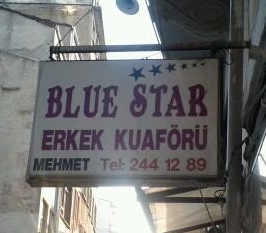
  Within a five-minute walk from my apartment in the middle of Istanbul, there must be 50 barbershops for men (erkek, or bay, kuaförü).  I don't know if this is because Turkish men are abnormally hairy, or if they just enjoy spending an afternoon sitting in a swivel chair inhaling hair tonic.


  For whatever reason, barbershops in Istanbul are the Turkish equivalent of a Starbuck's franchise in downtown San Francisco: they are everywhere. I want a latté, dammit (or a blow dry, as the case may be) and don't make me walk an extra 50 feet across the street to get one.  The barbershops also seem to be open continuously, as if there are just not enough hours in the day to deal with all the hair that needs to be cut.


  So I had no real excuse to let my hair grow long and shaggy as I approached my second month living in Istanbul.  But when you don't speak the language (and make no mistake, I don't),  getting a haircut becomes a high-stress activity.  Not only do you have to memorize essential haircut phrases  ("Just a little off the top," "The sideburns are crooked," and "Ow, that's my earlobe you just sliced off."), there is also the very significant danger of "barbershop small talk."   It's one thing to answer questions in a foreign language from a taxi driver or a waiter, because you always know the context:  this is a question about directions, this is a question about food.  But with barbershop small talk, there is no context, and all bets are off. 

  Crap.  Did he just ask me about the weather, or the political situation in Syria?

  You can only say "what?" or "I don't understand" so many times before you look like an idiot and the barber no longer wants to deal with you. When I would get my hair cut living in Belgium several years ago, I would have hour-long conversations with the barber while having almost no idea what he was saying to me.   I would just answer every question with a short laugh, a nod of the head, and a well-timed "Oui. C'est vrai. C'est vraiment vrai."  Which I'm sure led to conversations in French like this:

Belgian barber:  "You have no idea what I'm saying do you?"
Me:  "Ha.  Yes.  It's true.  It's really true."
Belgian barber:  "So you are actually a complete and total imbecile, is that what you are telling me?"
Me:  "Ha.  Yes.  It's true.  It's really true."

  The post-traumatic stress of the Belgian haircuts until now had effectively kept me out of the barbershops in Istanbul.   But the more I looked in the mirror and saw someone staring back resembling the Unibomber, the more I knew I had to suck it up and visit the kuaför.  When you start scaring Turkish children in the street, or, possibly drawing attention from the FBI, you know it's time to cut your hair.

  I decide to try a tiny barbershop just off the insanely busy Taksım Square, a shop with just enough room for three barber chairs and a single, affable-looking, grey-haired barber puttering around inside.  The name on the shop is "Barber," instead of "Erkek Kuaförü," along with (inexplicably) a sign that says "International Telephone."  I mistakenly take this as an indication that English may be spoken here.  


  English isn't spoken here.  As it turns out, nothing is spoken here.

  "Good afternoon," I say to the barber in the Turkish I rehearsed before leaving the apartment.  "I would like a haircut, please."  He says nothing, but nods and points me to a chair in the otherwise empty shop.   Without a word he wraps my neck with what looks like a white crepe-paper streamer, and drapes the familiar barber sheet over my body.  

  Meanwhile another customer comes into the shop, apparently a regular.  He greets the barber with an embrace and takes a seat in the last of the three chairs.  I tell the barber -- again, in my practiced Turkish -- that I would like it short on the sides, and a little longer on top.  The barber nods in a dismissive way that lets me know he's paying absolutely no attention to anything I'm saying.

  "Çay?" the barber asks me, invoking the Turkish custom that everything, including a hair cut, goes better with a glass of hot tea.  "Yes, please," I answer in Turkish.  He nods and goes out of the shop into the street, apparently looking for a tea vendor.
 
  The new customer, a professionally dressed guy in his mid 30s, looks over and smiles at me.

  "Ise tredin u el?" he says to me.  I try as hard as I can, but I can't decipher the Turkish.

  "Pardon?"

  "Ise tredin u el?"  the guy asks again. No, I'm just not getting it.

  "Sorry, um, ben Türkçe bilmiyorum," I say, telling him, flawlessly, that I don't understand Turkish.

  He waits a beat and looks at me like I'm an exceptionally challenged mental patient.  "I'm speaking English," he says, in perfect English.  "I asked, 'is he treating you well?' The barber."

  Oh. English.  My mother tongue. Yeah, I'm not very good with that either.  The guy immediately realizes I'm useless for barbershop small talk -- in any language -- and instead swivels the chair away to scroll through his Blackberry.

  The barber returns shortly with my glass of tea, and goes to work, again without saying a word.  He cuts my hair in the same way he received my hair-cutting instructions:  like a guy who's done this every day for the past 40 years and doesn't need anyone, let alone some Turkish-stammering moron, to tell him how to do it.  This is the Old School philosophy of "I'm cutting hair; not designing the nuclear reactor."  All which is fine with me. I'm thinking that at this rate I'll be out of the chair in less than 10 minutes.

   But no, it turns out the fun is just getting started.

  I notice for the first time on the counter to the left of me, a covered metal pot sitting on a hot plate.  Having finished cutting my hair, the barber now takes the lid off the metal pot, dips in something that looks like a wooden tongue depressor, and comes up holding a gob of bright green goo.  He first smears the green goo over both sides of the bridge of my nose.  The goo, it turns out, is hot wax.  He goes back to the pot then smears another glob of hot wax over and into my left ear, then another into my right.

  With hot wax clogging my ears I can no longer hear a thing.  I am now deaf, as well as Turkishly illiterate.  The barber holds out his hands and gestures in a manner telling me to drink my tea and wait a few minutes.  He shifts over to tending to his regular in the third chair. 

  As I sit there in silence, I stare into the mirror and take stock in myself:  sheared hair; barber's cape up to the neck; bright green wax covering the nose and ears.  What is it that I look like?  Yes, that's it: I look like a gremlin.  Not the cute, furry mogwai gremlins.  The evil ones, after someone's fed them after midnight.


  For not the first time in Turkey, I am completely convinced that I am being punked.  I am in the chair closest to the sidewalk, with nothing between me and the constant stream of passersby other than a big glass wall.  I sit and sip my tea, with a kind of quiet dignity that says to the world, "Yes, I realize I am appearing in public with bright green wax smeared in and around my orifices, what of it?"

  It takes me a few minutes to comprehend exactly what is happening here, but I start putting together the clues. Hot wax. Hot wax is used for ... wait.  Isn't hot wax used for hair removal? But he put the hot wax ... No, it's not possible, is it? Are my ... are my ears and nose ... are my ears and nose about to go Brazilian?

  There seems no other possibility, but my brain refuses to accept it. Yes, there is hair in my ears, OK, I'll give you that. But my nose? The bridge of my nose? I swear to you, I have been looking in the mirror for decades now, and I had no clue there was hair on the bridge of my nose. Why didn't someone tell me?  Who am I, Jo-Jo the Dog-faced Boy?


  The barber has now finished with his regular and turns his attention back to me and my wax job.  He wordlessly pulls the green wax off of my nose with one quick motion, like he's ripping off a Band Aid.  Ow! Hey, that kind of hurts.  Not a lot but, you know, a little.  This is because, as I told you, I have no hair on the outside of my nose.  The inside of my ears, however ...


  When he begins to slowly and methodically pull the wax out of my right ear, along with every single ear hair out of every last ear-hair follicle, I think this must be some kind of mistake.  No one outside of a hardcore S&M club would actually pay money to have this kind of pain inflicted on them, would they?

  Holy. Fricking. Begeezus.

  Hours later, when I can finally think clearly again, I contemplate whether an expletive had been invented to sufficiently express this level of pain.  The F-word doesn't cover it.  The S-word doesn't even come close.

  Is there a Z-word?

  I haven't figured out all of the behavioral customs of Turkey, but I am reasonably sure it is frowned upon for a fully-grown man to scream like a 2-year-old while sitting in a barber's chair.  Still, that almost doesn't stop me.

  After tearing out all of the hair from Ear No. 1, the barber holds out the wax in front of me, as if to say, "See? See how much hair was in your ear?  Aren't you glad I made you look ridiculous and put you through unspeakable excruciating pain? Look!"   I look at the ball of green wax he's holding and nod my head, but I can see nothing through the tears in my eyes.

  Now the barber moves to the other side of the chair for wax extraction from Ear No. 2.  Please, no, I'm begging you.  We'll just leave it like this.  I don't need to hear out of both ears!  Green wax plastered on the left ear is a good look for me.  We'll say it's something festive, for the holiday season! Just please don't tear every hair out of my ear aga ... YEAHHH OH HOLY MOTHER OF GOD!!

  If I'm being held by this barber at Guantanamo, at this point I tell him anything he wants to know.  He holds out Green Wax Ball No. 2 for my inspection.  See?  See?

  In addition to the obvious example of childbirth, I offer this as proof positive that women are more pain tolerant than men.  If someone came at me with a tongue depressor full of hot goo offering a bikini wax, I would hit the door and simply stay off the beach at Ipanema.

  With my nose and ears effectively de-haired, the barber finishes his services by moving behind the chair, putting his hands on my chin and the top of my head, making a quick twist, and cracking my neck like a back-alley chiropractor.  Perhaps he believes wincing and writhing in pain has thrown my spine out of alignment.

  At least there was no small talk.

  In the end, it turns out to be a pretty decent-looking haircut.  But you know, at this point, I'm thinking that while I'm in Turkey the Unibomber may not be a bad look for me. 

  Ha. Yes.  It's true.  It's really true.


Tuesday, November 29, 2011

Paris, with children

   I realize it is going to be a different kind of visit to the Musée d'Orsay when I see 2-year-old Teddy toddle over to the Rodin sculpture with one hand buried elbow-deep into the back of his diaper. 

"Look what your son is doing," Hannah says to J-P, in a voice implying that, at this particular moment, she is disavowing all claims to her second-born child.

"He has an itch,"  J-P offers in mild defense.
"Ugh. Boys are so disgusting."

If J-P wants to argue, his son is not helping the cause.  Teddy finishes his excavation and happily runs across the gallery floor to plant both hands against the base of the statue.

"I guess this is why they don't like you to touch the art?" I offer. 

Hannah just rolls her eyes and walks slowly after Teddy, who has already scampered on to the next gallery.  J-P follows pushing 4-year-old Sylvia in a stroller, as she happily sleeps her way past the impressionists well into the early part of the 20th Century symbolists. 

Ah yes, Paris: City of Lights, Fruit Roll Ups, and a Big Box of Huggies.  You know the Paris you see in movies, with Humphrey Bogart holding a glass of champagne and kissing Ingrid Bergman on the balcony over looking the Champs Élysées?  Yeah, this isn't it.

"The trick with having children in public," J-P tells me, "is to know when to leave just before they throw you out."   He says this after Teddy has spent some time climbing up and down the finger-like fur-covered couch at the entrance to the museum's Impressionists Wing.  The museum guard is just about to chase Teddy off the couch with a polite but firm "No shoes.  No shoes."  J-P closes his eyes, nods his head, and pushes the stroller toward the elevator.  "I guess our time is up."

      *      *      *
Hannah had issued the invitation to me a few weeks before Thanksgiving.  "We're going be in Paris at the end of the month.  Wanna come hang out with us?"  Having received very few invitations in my life to "come hang out with us in Paris," I wasn't about to decline this one.  But I had forgotten to look at the fine print:  "Come hang out with us."  Half of "us," as it turns out, was born after 2006. 

 This finally dawns on me a week or so after buying the plane ticket from Istanbul to Paris, when Hannah asks me for suggestions for a Parisian restaurant we can go to that is "child friendly."  Now why is she looking for a restaurant that is child-frien ... uh, oh.  Yes, I see now. "Child friendly."  As in "child care" and "child resistant" and "child labor" and "child-proof safety cap."  As in Guess Who's Coming to Dîner?

Honestly I'm not sure the Parisians are really familiar with the concept of a child-friendly restaurant.  In my visits to Paris, I do not recall having seen a Chuck E. Cheese's  (I may have missed it if it was re-branded as La Fromage de Charles E. or something).  The best I can come up with for "child friendly" is a place I remember in the center of Paris near Les Halles called Au Chien Qui Fume.   In English, that's "The Smoking Dog," or literally "The Dog who Smokes." 


  Showing my inexperience with children, I reason there is no child, in any culture, who wouldn't enjoy a restaurant with paintings on the walls of dogs with naked human bodies, smoking cigarettes.  Kids love dogs! Voila: Child friendly.  (J-P later asks if the name The Smoking Dog refers to a dog with a cigarette, or a dog on fire, both of which he finds disturbing.  "No, you are thinking of 'The Smoldering Dog,'" I tell him.  "That's across the street.")

As it turned out, a baby-sitter was located on this particular evening, so we did not have to inquire as to whether Au Chien Qui Fume offers a booster seat.   But I learn that you eat differently in Paris avec les enfants.  When you say "child-friendly," I think you are essentially looking for some place loud, that serves French Fries.  French fries you can throw on the floor.

I learn also that you travel around differently with children.  Distance is not necessarily measured in yards, meters, or metro stops, but instead in possible whining and/or tantrum episodes.  If one or more child is being carried by one or more adult, this also figures into the calculation.  The walk from the Musee d'Orsay to Rue Cler in the 7th Arondissement, for example, is a rather challenging 2.5 on the whining/tantrum risk scale.

Hence the tour of the palatial grounds at Versailles could not possibly be done on foot, but could in theory be attempted by golf cart.   I had been invited to join J-P, Hannah, Sylvia and Teddy at Versailles, along with their American friends now living in Paris Kate and Jim and their two kids: James, age 4, and Mary Martin, age 2.  A perfectly nice picnic is held in the garden just below the steps to one of Louis XIV's countless fountains.   The kids, apparently unimpressed by 18th Century opulence, ignore the fountains and enjoy rolling in the royal gravel.


About midway through the golf cart tour of the grounds, we reach a point that we believe is near the entrance to Marie Antoinette's Working Farm.  See, just down the road from a chateau that one of the Louis built for his mistress is a farm that Marie Antoinette apparently kept so she could go and watch how the other half lived.  I think.  I don't know, honestly.  For reasons that will become clear, we didn't get the audiotour.

In order to reach the alleged entrance to Marie Antoinette's Working Farm, we will have to dismount the golf carts and walk what under normal circumstances with normal adult humans would have taken about 10 minutes.  With two 4-year-olds and two 2-year-olds, it turns into the preschool version of the Bataan Death March, lasting a good half hour plus.  Sylvia is down out of the gate, tripping while running in the parking lot, and requires a carry from Dad the rest of the way.  James goes on strike about halfway there, announcing he wants to go home.  He sits down in the middle of the gravel road, refusing to go any farther.  It occurs to me that I could be been witnessing the birth of Occupy Versailles, but James eventually caves before the pepper spray comes out. 

Parents keep trying words of encouragement to keep childhood morale from deteriorating any further.  "Look up ahead, Mary Martin! See that!  We're almost there!" " Look, James! Sheep! Do you see the sheep?"   James has a look on his face that tells you immediately what he thinks you can do with your damn sheep.  

Finally it seems we have almost made it.  We had circumvented the walls of the village and can see what looks like a gate house at a small bridge up ahead.  The prize of Marie Antoinette's Working Farm will soon be ours.  But as we approach the gate, we can see something is wrong.  There is no ticket taker in the gate house.  The gate is sealed tight, with a small sign announcing in French that this particular entrance is closed for the season.  Please visit the farm by paying 8 Euro at the main entrance, around the other side, a good half mile away, the sign tells us. Merci, beaucoup!

"We are not walking back the way we came," Kate announces.  "I can tell you that much."

Jim looks over at the wall around the village, at the base of what appears to be a dried-up moat.

"How high to you think that wall is?" Jim asks.  "Six, seven feet?  If somebody gives me a boost up there, and somebody hands up the kids ..."

"Sounds good to me!"  Kate says, marching down into the moat bed with no further discussion.  "Come on, kids!  Wally World may be closed, but we're going in." 

I did not expect to come to Paris to participate in a re-enactment of "National Lampoon's Vacation."  But like the Griswold family, we have come this far, and we will not be deterred.  Minutes later five middle aged American lawyers grasp and grunt their way over the retaining wall into the compound of Marie Antoinette's Working Farm, handing up children like we're getting on the last chopper out of Saigon.   We're going over the wall, 8 Euro entrance fee and potential violation of international law be damned.

Far be it from me, the single guy with no kids, to ask if this is a good lesson for the children.  The point is, we need to cut through the farm to get back to the whine-free transportation of the golf carts.  Retreat is not an option.  And besides, we have Marie Antoinette's farm animals to see.  For the record, they pretty much look like everybody else's farm animals.  Except for the goat on the tree stump.  


Let them eat grain.

Hannah and J-P later keep apologizing to me profusely, as if they had unintentionally tortured me for two and half days.   Far from it; I had a great time.  The truth is, they have two beautiful kids who some day may or may not remember when Mom and Dad took them to Paris to play on fur-covered museum furniture and climb over 17th Century retaining walls.  Being there for that?  That's worth a flight in from Turkey any day.


Friday, November 18, 2011

I said what now?

I resigned myself early on to appearing idiotic while trying to speak Turkish.  I'm just now trying to come to terms with the dangers of being unintentionally profane.

The idiotic appeared almost immediately and returns on a daily (if not hourly) basis.  It's not too hard to accept, really.  This is not an easy language.  Not because it is particularly complex or illogical.  But more so because, to an english speaker, the words are just too damn much alike.  Yazmak is to write.  Yüzmek is to swim.  Yapmak is to do.  Yakmak is to light.  Now that you have that straight, would you like to conjugate those verbs?   Sooner rather than later, you will make an idiotic statment like this:

"Ben mektup arkadaşa yüzüyorum."
"You're doing what?"  Erendiz the Turkish teacher asks me.
"Um, mektup arkadaşa yüzüyorum?"
"You are swimming a letter to your friend?" he asks me sarcastically.  "This will take quite a bit of time, don't you think?"
    
Mm, yeah.  I'm swimming a letter to my friend.

Looking idiotic in Turkish class, however, is not a big deal.  "That's why you get paid the big money," I tell Erendiz.  "To listen to complete idiots like us mangle the Turkish language for four hours a day."   Like Erendiz, the restaurant people in Istanbul can be equally forgiving.  They are certainly no less amused.

"Çöp şiş, istiyorum,"  I confidently order from the waitress at the little restaurant around the corner. 
"Bu?"  she smiles and asks me.
"Çöp şiş?" I say again, repeating (or so I think) what I see written on the laminated menu next to a small photograph of what looks to be some kind of shish kabob.
"Çop şiş?" She asks again.
"Evet," I insist. "Çöp şiş."

What's wrong with these people?  It's written right there on the menu!  How can I possibly screw that up?

I figure it out on the way home, noticing the familiar word on a sign posted next to a vacant lot:  "Buraya çöp koymak yasaktır." (Putting garbage here is prohibited)

Çöp.  Çöp?

Ah, yes.  I see now. "Cop" (with a "C" instead of a "Ç" and an "o" instead an ö and pronouced Jawp) is a stick, or a baton, e.g., something a shish kabob would be cooked on, which is why this word appears on the menu.  "Çöp," on the other hand (that's with a "Ç" instead of a "C" and an "o" instead of an "ö" and pronounced Cheup), is the Turkish word for garbage.  That's right, my friends.  I was confidently proclaiming to my neighborhood waitress that for dinner, I would like her to please bring me their house specialty: the Garbage Kabob. 


Hey Ahmet, guess what the foreign guy out front wants you to cook for him?


I'm not denying it; mistakes were made.  I'm sure they continue to be made, with hilarious regularity.  None of this unexpected.  But I learned there are some words you have to be more careful with than others.

In Week One of my "Turkish for Foreigners" class, Erendiz introduces us to the words of frequency:  sometimes: bazen. never: hiç.  often: sık sık. 

Carla the Spaniard tries one of them out. "Sabahleyin sik sik kahve içiyorum," she says, trying to tell the class she often has coffee in the morning.  Erendiz winces and shakes his head. 

"No, don't ... don't say sik sik.  It's sık sık (suhk suhk)!  Not sik sik (sick sick)."
"Why?" Carla asks innocently. "What's sik sik?"
Erendiz won't tell us, but we find out later from a classmate's Turkish wife that while sık sık means "often," the nearly identical "sik sik" is the Turkish word for a particular male appendage, once repeated.

So, you know.  Don't say sik sik.  Unless you're into that kind of thing.  And whoever you are talking to is particularly hard of hearing.

Erendiz later tells us also about the dangerous proximity of the word bellowed by the junkmen in the street, hurdı! or scrap, and herif, which is the Turkish word for the English invective rhyming with "trucker."  Yes, that one (as "That mother herif just cut me off!")  Now I'm not sure if the junkmen hollering in the street are really looking for scrap, or just having a particularly bad morning.

Then there is the curious case of hayır vs. hıyar.  Hayır (prounced high - ur), is Turkish for "no," one of the most commonly spoken words in the entire language.  Hıyar (pronounced huh-yar) is ... look, there is no polite way to put this.  Hıyar is literally the Turkish word for "dickhead."  More or less our equivalent of calling someone an asshole.

It is also a cucumber.  And hayır, I'm not making that up.


Which I am reasonably sure had led to the following type of exchanges between me and Turkish waiters from the moment I arrived here.


Waiter:  (in Turkish) "Would you like anything else?"
Me:  "Dickhead, thank you, but I'm full."
Waiter: "No desert, anything?"
Me:  "Dickhead, really, there is dickhead possible way I could eat anything else.  Dickhead, just the check."

And so on. 

Clearly, my linguistic idiocy will continue.  At this point I'm just looking to limit the times I am in danger of being  punched in the face.


Thursday, November 10, 2011

Heard it on the streets

The first time I heard the propane gas truck approach my apartment, I almost ran out into the street to buy a chocolate dream cone.  I was sure that the Mister Softee ice cream truck had driven across the Atlantic from Brooklyn all the way to Istanbul.

From my open window I could hear the tinny little 20-note tune coming out the loud speaker, followed by two sung words.  Then again.  And again.  What the hell are they singing?  "Ay-Gaz!"  Aye, gas?  The possibilities that ran through my mind were that the Turks had some serious issue concerning lactose intolerance, or that this was possibly the worst song for an ice cream truck ever recorded.

But no, as advertised, it was the Aygaz truck, its flat bed filled with propane gas tanks.  If your propane tank is empty, apparently you simply have to wait until you hear the Aygaz music, take the empty tank out to the street, and swap it for a filled one.  Not as exciting as ice cream, clearly, but much more efficient than hauling your empty tanks to the propane store.


Thanks to the magic of globalization, you could live pretty much like an American in Istanbul if you chose to.  You could go to Starbucks for your morning coffee; shop at The Gap in the afternoon; grab a Whopper at Burger King for lunch; and order Domino's Pizza to be delivered for dinner.  


No, make no mistake: Istanbul is a big, modern city in many ways resembling any in Western Europe or North America.  But they still do some things here the old fashioned way.  One of those ways is to just haul their goods around the neighborhood, and announce -- usually by bellowing but sometimes by broadcasting repetitive jingles about propane - that a particular product is available for purchase.

The melon man is one of my favorites, if for no other reason than he hauls his melons around in a horse or donkey-pulled wooden cart that could have been constructed sometime during the Ottoman Empire.  (My guess is that Domino's probably abandoned the donkey cart for its pizza delivery early on, as it likely shot the "30 minutes or less" promise completely to hell).


Also seen and heard recently on my block was the Knife-Sharpener, who walked around hunched over with his unicycle- sized sharpening wheel strapped to his back.  Then there are the hurdacı, or junkmen, who push large, flat-bed carts up the cobblestone street calling out "Hurdı!"  which roughly translates as "bring down whatever really heavy crap you want to throw out that the garbage men won't take." 

And of course, there is the Sock Man. "Çoraplar! Çoraplar!"  The morning I saw him, he was offering three colors:  black, blue, and for some unexplained reason, red.  Really? Do you mean to tell me, that I can simply open my window in the morning, and buy socks? Red socks?  This seems like a dream come true to me.  If the underwear man puts Başkürt street on his route, I may never do laundry again.


Take me home, Country Yollar

I've come to the conclusion that we Americans are way too concerned about looking stupid in public.  Not unintentionally acting stupid; we don't seem to have any problem with that.  No, I'm talking about the fear that, by simply having fun and showing it out in the open, people will roll their eyes at us and whisper to others that we are just so, you know: undignified.  As if by making an ass out of ourselves, we will just never, ever be elected student counsel class president as we always dreamed.

This first occurred to me several years ago, as I watched a table of a dozen or so large Austrian people outside of a Tyrolean ski lodge raise their beer mugs and belt out a perfectly horrendous rendition of "Take me Home, Country Roads."  It was the middle of the day. They were not drunk, but smiling and laughing and having fun and looking and sounding ... just so ridiculous.   This was a John Denver song, for God's sake, being sung in bad German/English (Genglish? Gerlish?) smack dab in the middle of lederhosen country.  Did they even know where West Virginia was, or why they would belong there? I was fascinated watching this, thinking I would even be embarrassed to have this song playing on my car radio with the window down, for the fear that someone might pull up along side and ridicule me.  But the Austrians laughed and clinked their glasses and sang at the top of their lungs, and and could have cared less what I thought about it.  You know: they were having fun.

I thought about this again last year, as I spent a week hanging out in some of the finer pubs of Ireland, from Dublin to Galway to Killarney to Cork and back again.  In almost every pub in the evening, there was a musician.  Usually one guy, with a guitar, and a pint of Guinness in front of him.  And he'd sing, and people would sing along, and clap, and stomp their feet, and dance.   After three or four pubs, you know all the songs.  And after three or four Kilkenneys and a shot of Jameson or two, I was singing and clapping and stomping my feet, too.  I'm sure I appeared about as dignified as an Austrian singing a John Denver song, but man! it was fun.

I rediscovered this yet again this week during my first visit to a Turkish music bar.  The crowd at La Fee (located on Fransiz Sokaği, or "French Street") was young and good looking, almost all under 30.  If any people would be concerned about appearances, it would be them.  As in Ireland, on stage was just a guy with a guitar, playing songs that everyone knew (well, every Turkish person knew, anyway).

In America, we treat live music in a bar as background noise, raising our voices to talk over it like it is a screaming baby on an airplane.   In Turkey - at this particular bar on this particular night, at least - the live music is a participatory sport.   People clap.  They pound the table.  They dance.  They sing along like no one is listening.  And if anyone thinks they look or sound stupid, they certainly don't seem to care. 


I have seen this, and I'm telling you, we really need to give it a try.  I know people who will not sing Happy Birthday in public because they are worried that others will not think they are not a good enough singer.  Try to keep in mind: it's Happy Birthday. Not the tryouts for American Idol.   Loosen up, make an ass out of yourself.  Turn up the car radio and dance in your seat at the stoplight.  Tell the next guy you see in a bar with a guitar (if you should ever happen upon one) to play John Cougar Mellencamp, and have everyone join in on the refrain of Jack and Diane.  And sing frickin'  Happy Birthday, for crying out loud.  Life is too short to not occasionally look stupid.

O, Brother Fish

Years ago when I was married, my now ex-wife dragged me to an amateur play, starring, written and directed by the husband of a friend of friend of a coworker (I think).   The play was put on in a barn somewhere outside of Pittsburgh.  The audience sat on haystacks, and the play lasted for what seemed like three and a half days.  I'm pretty sure we were in complete agreement that the play was auspiciously terrible.

If I remember correctly, the play was supposed to tell the story of early native Americans, and how they loved and respected nature.  As the play opens, the actors - portraying a hunting party - pantomime killing a deer.   One of the actors kneels over the ersatz deer, raises his head and arms to the sky, and belts out:  "O, BROTHER DEER!  WE ARE SORRY THAT WE MUST EAT YOU!!"  The deer, still dead and no longer accepting apologies, says nothing. 

This classic line became oft-repeated in the coming years, any time food arrived at the table in a restaurant looking less like food and more like something that until recently had been happily walking, swimming, or flying around.  I repeated it again this week, as I visited one of the countless seafood restaurants of the Balık Pasajı (Fish Passage), off of Istanbul's Istiklal Ceddesi (Independence Avenue).   When you order "Grilled Sea Bass,"  this is exactly what you get:  one sea bass, grilled.   Head, tail, fins, eyes, gaping mouth.   No one is going to fillet this for you, or make it look pretty.  You want grilled sea bass?  Here it is: Fwap!  One grilled sea bass. You want to eat?  Get to work.

"O, BROTHER FISH ...!"


I can report that Brother Sea Bass, God bless him, with a little salt and pepper and lemon juice, was quite tasty.  Like his kindred brother deer, however, he refused to accept my apology for eating him.  

He looked a little pissed, to be honest with you.


Friday, November 4, 2011

Turkish for Foreigners

Erendiz starts off the class looking something like the Sean Penn of Turkish language teachers. Dressed in a white t-shirt, leather vest, and motorcycle boots, he walks in and shuts the door behind him, stalking into the classroom like he’d just as soon punch someone in the face than conjugate a verb.

Surveying the beginner’s class in front of him, Erendiz gives off the vibe of someone who’s been through this before and is not particularly looking forward to doing it again. Like the drill sergeant in "An Officer and a Gentleman," you have the sense that he’s about to tell us that we are the saddest bunch of non-Turkish speaking rejects it has ever been his misfortune to see. At this point, no one present is in a position to argue.

There’s Manu, a shaggy haired Belgian web designer by way of Mauritius who was on his way back to Europe from Lebanon when he decided he’d stop off in Istanbul three days ago to see what all the fuss was about. He knows zero Turkish. Then Fardous, a nice Syrian woman who was teaching English in London and becoming increasingly distressed watching the civil unrest in her home country on satellite television. To distract herself, she told me, she came to Istanbul to live for a while. She knows zero Turkish.

Then there are the two Russian woman, Maria and Natalia. Maria is there because, she tells me, she was crazy enough to marry a Turkish man. She doesn’t seem particularly happy about it. Natalia is some sort of economist. She won’t say much more that. Rounding out the class is Christian, an Italian who also married a Turk; Cana, a German girl of Turkish decent who has come from Hamburg to live with her aunt; and yours truly, the American with the back story more dubious than the rest of them combined.

There we sit before Erendiz: A more poorly-dressed version of a United Colors of Benetton ad. Fortunately for me, everyone in the class speaks English to one degree or the other. Turkish? Mm, not so much. For all intents and purposes, not at all. He runs his fingers through his spiked hair, takes a deep breath as he rubs the razor-cut beard along his jawline, and lets the Turkish fly.

"Merhaba! Nasılsınız? Benım adım Erendiz.  Sizin adınız ne? Nereden geliyorsunuz? Ne iş yapıyorsunuz?"

As the multi syllabic words pour out, Manu seems to grow a bit terrified. Natalia looks around the room and appears like she just might possibly throw up. Maria crosses her arms across her chest and scowls in disgust.

"How are we to know this!" Maria finally blurts out. "This is beginner’s class! We don’t understand you! We do not speak Turkish!"

Erendiz finally drops the Sean Penn bit and cracks a smile. "I know," he tells her. "Trust me; this is my job. I’m going to teach you."

* * *

Welcome to Yabancı Dilim Türkçe No. 1, which roughly translates to the mildly insulting "Turkish for Foreigners." You have to expect a bit anxiety on the first day of any school, I have to think. Turkish from Scratch (as the course should be called) – taught by in the heart of Istanbul by a guy wearing a shark-tooth necklace – takes it up a notch.


We find out later that Erdeniz’s favorite movies are "Rocky," "Rambo II," and "The Terminator." His friends affectionately call him "Psycho." But like the smoking green liquid on the Turkish coffee serving tray, his act is mostly just for show. Erendiz turns out to be a patient and good-natured teacher, who apparently just enjoys screwing with the neophytes for a while before launching into the first few hours of intensive Turkish lessons. But this is not immediately apparent in the first hour.

The lesson continues. Erdeniz asks Maria the Russian where she lives in Istanbul. "Nerede Istanbul’da oturuyorsunuz, Maria?" After a three-second death stare, Maria again explodes.

"I cannot say this ... this ... oturye yo yo ye! It makes my brain to hurt!"

"Yes you can say it."

"No, I can not!"

"Yes you can."

Erdeniz seems unwaveringly confident that he can teach Turkish to anybody. But at this point I’m not so sure Maria isn’t on to something. It feels a bit like you’ve landed on another planet, and it will take years to crack the alien code.

Still, this just is the first week, and I’m determined to do this. I pay attention in class and do the homework. I go home each night and write out the vocabulary, inventing word games to associate the Turkish word with some absurd image in an attempt to memorize it. "Ok, the word for "high" is yüksek (youk-sec). Yuksek. Yuksek. Yuksek. Ok, if Bob Uecker (Youk) drank a lot of triple sec (sec), he would get high. Yuksek." "Pepper is karabiber.   Karabiber, karabiber. Ok, if Justin Beiber had a sister, her name would be Kara. And I would have to assume she would be peppery. Karabiber." "Ice is buz. Buz, buz, buz. If you eat ice too fast, you get one of those cold headaches, and it gives you a buzz." For hours I do this. Yes, it is stupid as hell. But you tell me a better way to try to memorize that Çarşamba is the day before Perşembe.

* * *

On the second day of class, I am tagged with the nickname of "Superman." Sorry, but I am simply reporting the facts. I think it as has something to do with my black-framed, Clark Kent-like glasses, and the fact that I have actually done the homework. It seems like pretty low bar, but I guess I’ll take it.


Erdeniz’s lessons continue. Students scratch their heads. Manu responds to questions with the startled stare of a cornered animal. Maria continues to rant about the injustices of the Turkish language.

But I’m keeping up with Erdeniz, and persisting on the vocabulary. Thirty new words to memorize. Then 50. Then 100. Some Turkish words you luck out on. You can pretty much figure out otel and taksi and radyo and televizyon. But good luck with refrigerator (buzdolabu), or orange (portakalrengi), or shoes (ayakkabılar) or computer (bilgisayar). 

Then there are the identical words that mean entirely different things.  Yüz means one hundred. It also means a person’s face.   Mısır is the country Egypt. It is also corn. Ocak is a stove. It is also the month of January.   Upon discovering this, I decide that we also should consider changing the name of one of our months to that of a kitchen appliance. I would be more than happy to celebrate my birthday on the 29th of Salad Spinner, or fireworks on the 4th of Toaster Oven. But I digress ...

* * *

The jig's up on the third day of class, when Erdeniz decides while teaching us numbers that it would be a good idea to go around the room and have everyone say in Turkish what year they were born. I know I am in serious trouble when the first birth year comes in around the mid 1980s, about the time I was driving a Pontiac Fiero and dancing to Scritti Politti. For a split second, I consider shaving 10 years off of my age, realizing everyone here, including Erdeniz, is at least 15 years my junior. But no, I suck it up and take it like an adam.

 "Bin, dokuz yüz, altmış bir."
 
A stunned silence hangs in the air. You can almost hear everyone in the entire room collectively thinking: "Did he say Nineteen Sixty One?" I am immediately convinced I have just lost the respect of the class, along with my cheaply earned but highly prized nickname. I try to comfort myself by recalling that, back on Krypton, Superman’s father was played by Marlon Brando. Maybe I could be Jor-El.

The Turkish keeps coming fast and furious. We progress from "Hello, my name is ..." to "What is this? This is a pen." to "There is water in the bottle." to "In general, I shave every morning before breakfast." While the over/under odds on one of the Russians dropping the class is running at around 2.5 days, everyone is hanging in there. Erdeniz actually seems to be enjoying this. And after just a few days, I’ll be damned if we aren’t learning some frickin’ Turkish.

* * *

Erdeniz begins the fourth day of class with an announcement.

"At the beginning each class, I appoint someone to be captain of the class," he says, "to be the leader and coordinate all social arrangements."

"Superman!" the class blurts out in unison.

Erdeniz points at me. "Yes, Superman. You are the captain." He adds that my new Italian friend, Christian, will be the second captain (in the event that, like the winner of a beauty pageant, in the next year I am for any reason unable to perform my duties).

"So I guess this means I’m no longer Superman," I say as way of my acceptance speech. "I guess this makes me Captain America."

"Yes!" Christian points and shouts. "You are Captain America! Ah, Steve Rogers! And me, I am Bucky Barnes!"

"OK, Captain," Erdeniz says, getting back to work. "Now, let’s hear you conjugate alışveriş yapmak. Positive and negative forms."

The struggles of the Benetton refugees continue for another day. But after the first week, score one point for the old American guy in the Clark Kent glasses.